
Importance of Preschool Education in Early Childhood Development
September 14, 2026
Key Differences between Montessori vs Traditional Preschool – 2026
September 18, 2026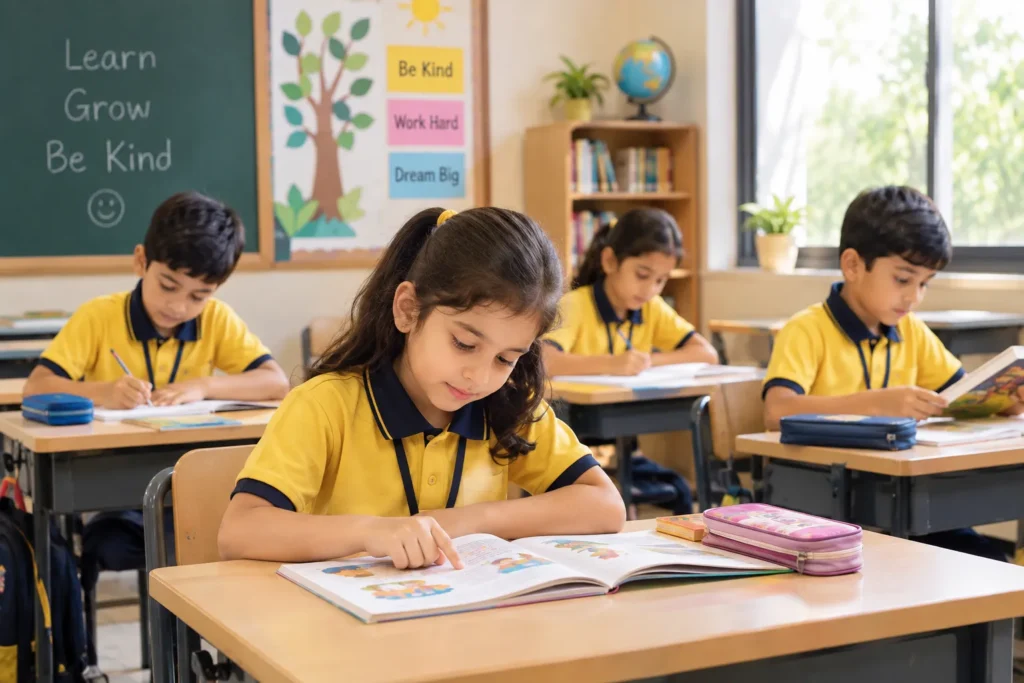
Key Differences between Elementary School and Primary School – 2026 Edition
If you’ve ever googled elementary school vs primary school when searching for schools for your child, you may have wondered if the two terms refer to different stages of education. Short answer: sometimes the terms are used interchangeably, but it is contingent upon the country and education system.
In India, the situation becomes particularly interesting because the language parents use does not always match the terminology used in current national education policy. Many families casually use ‘primary school’ for the early years of formal schooling, while ‘elementary school’ may appear on international websites, school materials or when discussing the American education system.
This distinction matters when you are choosing a school. A school’s name tells you far less than its curriculum, age range, teaching approach, teacher quality, safety standards, assessment practices and support for children.
According to UNESCO’s International Standard Classification of Education (ISCED), primary education is designed to establish fundamental skills in reading, writing and mathematics while supporting personal and social development. UNESCO also notes that programmes at this level can be called primary, elementary or basic education in different systems.
India has also changed the way early schooling is structured. Under the National Education Policy (NEP) 2020, school education follows a 5+3+3+4 curricular and pedagogical structure. The Foundational Stage covers ages 3 to 8, while the Preparatory Stage covers Grades 3 to 5.
So, if you are trying to understand elementary school vs primary school, do not stop at the labels. Look at what those labels mean in the specific country, board and school you are considering.
Elementary School vs Primary School: The Short Answer
In everyday usage, ‘elementary school’ and ‘primary school’ can refer to broadly the same level of early schooling. The difference is mainly geographical and structural rather than a universal difference in educational quality.
In the United States, ‘elementary school’ is the common term for the first years of school. In the United Kingdom, India and many Commonwealth systems, ‘primary school’ is generally the preferred term. Cambridge Dictionary reflects this distinction by describing primary school as the term used in the UK and other countries, while noting that in the US it can refer to a shorter early stage or to elementary school.
UNESCO’s ISCED framework makes the terminology issue even clearer. It states that programmes classified as ISCED Level 1 may be referred to as primary education, elementary education or basic education, although ‘primary education’ is used as the international label for comparison.
That means a parent should be cautious about assuming that an ‘elementary school’ is automatically different from a ‘primary school’. The grades covered, age range and curriculum are more useful indicators.
Why Do the Terms Elementary and Primary Mean Different Things in Different Countries?
Education systems developed under different historical and administrative traditions. As a result, countries use different names for broadly comparable stages of schooling.
The UNESCO UIS ISCED 2011 framework was created partly to make these systems easier to compare internationally. It identifies primary education as ISCED Level 1 and explains that the level is known by different names across countries.
This is why an online article written for American parents may use ‘elementary school’, while an Indian school website may use ‘primary school’. Neither term is inherently better. They are labels within different educational contexts.
For Indian parents, the practical question is therefore not ‘Which word is correct?’ It is ‘Which grades does the school actually cover, what curriculum does it follow, and how does it teach children at that age?’
What Does Primary School Mean in India?
Traditionally, primary education in India has commonly referred to the first five years of school, Classes 1 to 5. Government school classifications still use ‘primary’ for schools offering Grades 1 to 5 in many datasets. For example, NITI Aayog’s recent education data describes ‘Primary Only’ schools as those offering Grades 1 to 5.
However, NEP 2020 introduced a developmental structure that changes how these years are grouped. The Foundational Stage includes three years of pre-school or Anganwadi/Balvatika plus Classes 1 and 2, covering ages 3 to 8. The Preparatory Stage then covers Classes 3 to 5, generally ages 8 to 11.
This means Classes 1 and 2 are now conceptually part of the Foundational Stage rather than being treated simply as the first two years of a conventional primary block.
The Ministry of Education’s NEP 2020 document explains that the new structure is designed around children’s developmental needs, with pedagogy becoming progressively more formal as learners move from the Foundational to Preparatory Stage.
For parents, this distinction is useful because it explains why a modern Indian school’s early years may look different from the traditional image of primary school. The policy direction is towards foundational literacy and numeracy, activity, discovery, play and age-appropriate learning before moving into more structured academic engagement.
What Does Elementary School Mean?
‘Elementary school’ is most strongly associated with the United States and is commonly used for the first years of compulsory schooling. The exact grade span varies by school district and state, so there is no single universal US definition that fits every school.
The term can also appear in international education discussions as a synonym for primary education. UNESCO explicitly recognises elementary education as one of the names used for ISCED Level 1.
The important point is that ‘elementary’ does not automatically tell you the age of the child, number of grades or curriculum. Those details have to be checked within the relevant education system.
For an Indian family comparing an international school, a foreign curriculum or schools using American terminology, asking about grade equivalence is much more reliable than comparing labels.
Elementary School vs Primary School: Key Differences
| Point of comparison | Primary school | Elementary school | What parents should check |
| Common usage | India, UK and many Commonwealth systems | Common in the US | Country and curriculum |
| Typical purpose | Foundational academic and personal development | Foundational academic and personal development | Learning goals |
| Grade span | Varies by education system; often Classes 1 to 5 in India | Varies by district/system | Exact grades offered |
| Curriculum | Depends on board and school; India is moving to 5+3+3+4 | Depends on state/district and school | Board or curriculum framework |
| Teaching approach | Increasingly activity-based and competency-focused in early years | Often age-appropriate, with variations by school | Classroom practice |
| International comparison | Often used as the international term for ISCED Level 1 | Can be used as a synonym for primary | Check equivalence, not name |
The Biggest Difference Is the Education System, Not the Name
The table above shows why a direct one-to-one comparison can be misleading. A school called ‘elementary’ in one country may cover a different number of grades from a school described as ‘primary’ elsewhere.
The UNESCO ISCED framework recommends looking at the actual educational level and learning objectives rather than relying only on national terminology. Primary education generally develops basic literacy, numeracy, knowledge and personal and social development with limited specialisation.
In other words, the word on the school sign is not the deciding factor. The child’s age, grade, curriculum, learning outcomes and progression route tell you much more.
Elementary School vs Primary School in India Under NEP 2020
If you are a parent in India, NEP 2020 is the most important context for understanding today’s terminology. The policy replaces the older 10+2 structure with 5+3+3+4, covering ages 3 to 18.
The Ministry of Education explains that the four stages are Foundational, Preparatory, Middle and Secondary. The Foundational Stage includes three years of pre-school plus Classes 1 and 2, while the Preparatory Stage covers Classes 3 to 5.
This is not merely a change in labels. The policy says curriculum and pedagogy should respond to the developmental needs and interests of learners at different stages. The Foundational Stage is intended to use flexible, multilevel, play and activity-based learning.
The Preparatory Stage gradually introduces more formal classroom learning while continuing play, discovery and activity-based methods. A 2026 PARAKH NCERT article on the Preparatory Stage describes this stage as a bridge between early childhood learning and more specialised subject-based learning.
This distinction can help parents understand why Class 1 and Class 2 may feel different from Classes 3 to 5 even though both are commonly called ‘primary’ in everyday conversation.
What Children Learn in the Early Primary Years
Whether a school uses the term primary or elementary, the early years should establish essential knowledge and learning habits. UNESCO identifies reading, writing and mathematics as central purposes of primary education, but a child’s development is broader than these three areas.
- Language and communication: listening, speaking, vocabulary, reading and writing.
- Foundational numeracy: counting, number sense, operations, patterns, measurement and mathematical reasoning.
- Environmental understanding: observing the natural and social world and making connections.
- Social and emotional development: cooperation, empathy, confidence, self-regulation and responsible behaviour.
- Physical development: coordination, movement, health and wellbeing.
- Creative development: art, music, drama, craft and other forms of expression.
- Thinking skills: questioning, reasoning, problem-solving, curiosity and applying knowledge.
The NCERT National Curriculum Framework for the Foundational Stage takes a similarly holistic view, including physical and motor, cognitive, socio-emotional and ethical, cultural and artistic development alongside communication, early language, literacy and numeracy.
Why Foundational Literacy and Numeracy Matter
A child may move through the grades successfully while still struggling with basic reading or number concepts. That is why foundational learning has become such a major focus in Indian education policy.
The NIPUN Bharat and Foundational Literacy and Numeracy resources emphasise joyful learning through play, stories, rhymes, activities, local art, craft and music while developing strong foundations for lifelong learning.
UNICEF India also highlights the connection between quality early learning and later educational outcomes. Its early childhood education work notes that high-quality early learning can improve learning outcomes and reduce the likelihood of repetition and dropout.
This is an important point when comparing schools. A strong primary programme is not simply one that gives more homework. It is one that makes sure children understand the basics deeply enough to use them in new situations.
How Teaching Changes From Foundational to Preparatory Years
One of the clearest practical differences parents may notice is the gradual shift in classroom style. In the Foundational Stage, learning is expected to be flexible and play or activity based. Children learn through stories, games, conversation, movement, exploration and hands-on experiences.
By the Preparatory Stage, teachers can introduce more systematic reading, writing, mathematics and other curricular areas while retaining interactive and experiential methods. PARAKH NCERT describes Classes 3 to 5 as a stage where light textbooks, written work and more formal classroom routines are introduced progressively.
That progression is important. Children should not be expected to make a sudden jump from play-based learning to highly formal instruction. A good school builds the bridge gradually.
Elementary vs Primary: Is One Better for Your Child?
No. The label itself does not make one school better than another. A primary school and an elementary school can both provide excellent education if the programme is well designed, teachers are capable and the environment meets children’s developmental and educational needs.
Parents sometimes get caught up in terminology because ‘elementary’ can sound international or because ‘primary’ feels more familiar. But neither word is a quality indicator.
A better way to compare schools is to ask: What will my child experience every day? How will teachers support reading and numeracy? Is there time for movement and creativity? How are children assessed? How does the school support children who need additional help?
Those questions reveal considerably more than the school’s chosen terminology.
How to Choose a Primary or Elementary School in India
1. Check the Board and Curriculum
First identify whether the school follows a national, international or state curriculum. Ask how the curriculum is mapped to the child’s age and grade, and how learning outcomes are communicated to parents.
2. Look Beyond the Brochure
A polished website can tell you about facilities, but a classroom visit can tell you how children actually learn. Observe whether pupils are engaged, whether teachers listen, and whether activities involve meaningful participation.
3. Ask About Foundational Learning
Find out how the school teaches reading, writing and mathematics. Ask whether teachers use stories, concrete materials, discussion, games and problem-solving rather than relying entirely on memorisation or worksheets.
4. Understand Assessment
Assessment should help teachers understand what children know and what support they need next. India’s competency-based assessment reforms increasingly emphasise broader evidence of learning rather than marks alone. PARAKH NCERT describes holistic progress cards designed to capture learning across curricular elements and competencies.
5. Consider Teacher Quality
The teacher-child relationship can shape a child’s experience of school. Ask about teacher qualifications, professional development, classroom size and how teachers communicate with families.
6. Check Inclusion and Individual Support
Children learn at different rates. Ask how the school identifies learning needs, provides additional support and makes classroom experiences accessible to children with different abilities, languages and backgrounds.
7. Think About the Transition
A good school should help children move smoothly from one stage to the next. UNICEF India describes school readiness and transitions as involving children, schools, families and communities, not children alone.
Primary School vs Elementary School: What Parents Should Not Assume
Do not assume the grade range
The same term can cover different grades in different countries and school districts.
Do not assume the curriculum
A school called elementary can follow a national, state, international or private curriculum.
Do not assume the teaching style
School terminology does not tell you whether teaching is play-based, project-based, textbook-led or mixed.
Do not assume academic quality
Results, teacher quality, learning support and classroom practice are more meaningful indicators than the name.
Do not assume international equivalence
If your child is moving between countries, ask the school to explain grade and curriculum equivalence in writing.
Elementary School vs Primary School for Children Moving Between Countries
This distinction becomes especially important for families relocating internationally. A child transferring from an Indian school to a US school, for example, may encounter ‘elementary school’ rather than ‘primary school’.
Do not judge the child’s placement by the school name alone. Share the child’s current grade, age, curriculum, subjects studied and recent learning information with the receiving school.
UNESCO’s ISCED framework is useful for international comparison because it focuses on educational levels and characteristics rather than simply the names used by individual countries.
Parents should also ask whether the new school has a transition or orientation process. Differences in terminology can be easy to manage when the school clearly explains grade placement and expected learning outcomes.
Role of Parents in Primary and Elementary Education
Parents are not expected to become teachers at home. However, everyday conversations and routines can reinforce what children are learning at school.
- Read together regularly and ask your child to talk about the story.
- Encourage children to explain how they solved a simple problem instead of giving the answer immediately.
- Use everyday situations such as shopping, cooking and travel to practise counting, comparison and measurement.
- Give children time to play, draw, build, move and talk. These activities can support learning alongside formal schoolwork.
- Stay in contact with the teacher so small learning difficulties can be addressed before they become bigger gaps.
UNICEF’s guidance on early learning in India places importance on family participation and on creating continuity between home, early childhood settings and school.
How a Strong Primary Classroom Should Feel
There is no single perfect classroom, but a strong early-years environment usually feels purposeful without feeling unnecessarily pressured. Children should know what is expected while still having opportunities to ask questions, make choices and learn from mistakes.
The NCERT framework emphasises learning through concrete experiences and interaction. In practice, that means children should not spend the entire day copying from a board or completing repetitive exercises.
They should also have structured opportunities to practise important skills. A balanced classroom might include direct instruction, reading time, discussion, independent work, group tasks, creative activities and physical movement.
The goal is not to eliminate academic structure. It is to make the structure appropriate for the child’s developmental stage.
Questions to Ask a School Before Admission
- What grades and age groups does the school actually cover?
- Which board or curriculum does it follow?
- How does the school interpret the Foundational and Preparatory Stages?
- How are reading, writing and mathematics taught in the early grades?
- How much time do children spend on play, outdoor activity, art, music and hands-on learning?
- How are children assessed and how is progress shared with parents?
- What happens if a child is ahead of the expected level or needs additional support?
- What are the average class sizes and teacher qualifications?
- How does the school support the transition between grades?
- How does the school involve parents in children’s learning?
Frequently Asked Questions
Is elementary school the same as primary school?
Often, yes, in the broad sense that both terms can describe the early stage of formal schooling. However, the exact grades and age range vary by country. UNESCO recognises elementary education as one term used for primary education at ISCED Level 1.
What is the difference between elementary school and primary school in India?
In India, ‘primary school’ is the more familiar term, traditionally associated with Classes 1 to 5. ‘Elementary school’ is more commonly encountered in international or American contexts. Under NEP 2020, Classes 1 and 2 are part of the Foundational Stage, while Classes 3 to 5 form the Preparatory Stage.
Which is better, elementary or primary school?
Neither term is inherently better. School quality depends on curriculum, teachers, classroom practice, assessment, inclusion, safety and how well the programme meets children’s developmental needs.
What age is primary school in India?
Age varies by school entry rules and individual circumstances. Under NEP 2020, the Foundational Stage covers ages 3 to 8, including three years of pre-school plus Classes 1 and 2, while the Preparatory Stage generally covers ages 8 to 11 in Classes 3 to 5.
Is Class 1 primary school or elementary school?
In common Indian usage, Class 1 is part of primary schooling. Under NEP 2020, it is also part of the five-year Foundational Stage. In American contexts, the equivalent early grade would usually be described as part of elementary school.
Does elementary school mean the same thing worldwide?
No. The term varies by country and sometimes by state or school district. Always check the grades, age range and curriculum rather than relying on the label.
What should parents look for in a primary school?
Look for qualified teachers, a safe and inclusive environment, strong foundational literacy and numeracy, appropriate assessment, active learning, opportunities for creativity and movement, and clear communication with families.
Why is foundational learning important?
Foundational literacy and numeracy give children the tools needed to understand later subjects. Indian education policy places strong emphasis on ensuring these competencies are developed during the early years.
This checklist is deliberately simple. A parent does not need to know every educational theory to identify a school that takes children’s learning seriously. Look for evidence in the classroom, listen to how teachers describe their practice and ask for specific examples rather than relying only on promotional language.
Transition: Does the school actively help children move between stages and adjust to changing expectations?
Communication: Do parents receive clear, useful information about progress and areas for support?
Assessment: Does assessment identify learning needs and guide teaching, rather than simply rank children?
Inclusion: Can the school adapt learning for children with different needs, abilities and languages?
Wellbeing: Are movement, relationships, emotional support and physical wellbeing treated as part of school life?
Foundational skills: Is there a clear plan for reading, writing and numeracy?
Teaching: Do teachers use explanation, discussion, practice, activities and hands-on experiences in a sensible balance?
Curriculum: Is the programme clearly structured and appropriate for the child’s age and stage?
A Practical Checklist for Comparing Schools
Parents should therefore ask how assessment information is used. The important question is not only ‘How often are children tested?’ but ‘What does the teacher do with what they learn from assessment?’
For young children, observation can be particularly useful. A teacher may learn more by watching a child explain a solution, read aloud, collaborate on a task or apply a mathematical idea than from a short worksheet alone.
India’s assessment reforms under NEP 2020 increasingly emphasise competency-based and holistic approaches. PARAKH has developed Holistic Progress Card approaches intended to capture learner progress across curricular elements and competencies rather than reducing progress to a single score.
Assessment is another area where parents should look beyond marks. A test can show whether a child answered particular questions correctly, but good assessment should also help teachers understand how the child thinks, communicates and applies learning.
The Role of Assessment in Primary Education
A strong programme should make language a bridge to learning rather than turning language difficulty into a hidden barrier.
UNICEF India has also highlighted the value of learning options in children’s mother tongue when discussing foundational learning. For parents, the practical question is how a school supports comprehension while children develop proficiency in the language of instruction.
NEP 2020 places emphasis on the use of children’s home or familiar languages in the early years where possible, while also recognising the importance of multilingualism. The aim is not to limit children to one language, but to build understanding while expanding their linguistic abilities.
Language can affect how comfortably a child participates in learning. A child may understand a concept but struggle to express it in an unfamiliar language. This is especially relevant in multilingual Indian classrooms.
Why the Medium of Instruction Matters
For parents, this means asking practical questions about transition rather than focusing only on admission dates. Find out how the school introduces new routines, how teachers communicate with families and what happens if a child takes longer to settle.
UNICEF India describes school readiness as a shared responsibility involving children, schools, families and communities. This is a useful way to think about the move into primary education. The child is not the only one who needs to be ‘ready’; the school also needs to be ready to welcome and support the child.
A supportive school prepares children for these changes instead of expecting them to adapt overnight. Teachers can explain new routines, maintain familiar learning approaches where appropriate and give children time to become comfortable with new expectations.
Transitions can be surprisingly important for young children. Moving from preschool into Class 1, from Class 2 into Class 3, or from one school system to another can change routines, expectations, teaching methods and assessment practices.
How Schools Can Make the Transition Easier
In an Indian context, the same principle appears in the direction of NEP 2020 and the national curriculum frameworks. Learning should become progressively more structured, but it should remain connected to children’s developmental needs and experiences.
UNESCO’s description of ISCED Level 1 makes this broader purpose clear. Primary education is intended to develop fundamental literacy and numeracy while also supporting personal and social development. It is not simply a period of memorising facts.
Reading and mathematics are essential, but children are also learning how to organise ideas, listen to another person, explain an answer, work with classmates, manage frustration and approach unfamiliar problems. These abilities influence how effectively children use academic knowledge.
Parents often think of primary education as the period when children finally start doing ‘real’ academic work. That is understandable, but it misses a large part of what children are developing at this age.
Conclusion
When comparing elementary school vs primary school, the biggest thing to remember is that the two terms do not represent a universal global divide. In many contexts, they describe broadly similar stages of early formal education, with the preferred word changing from one country to another.
For Indian parents, however, there is an additional layer because NEP 2020 has reorganised school education around developmental stages. Classes 1 and 2 sit within the Foundational Stage, while Classes 3 to 5 form the Preparatory Stage. This makes the child’s learning experience more important than the label attached to the school.
A good school should build strong foundations in language and literacy, numeracy, communication, reasoning, social development, physical wellbeing and creativity. It should also gradually prepare children for more structured learning without making the early years unnecessarily stressful.
So, when choosing a school, do not ask only whether it is ‘elementary’ or ‘primary’. Ask what your child will learn, how they will learn it, who will teach them, how progress will be understood and what support will be available when they need it.
The name may help you understand the education system. The quality of the experience is what will shape your child’s journey.