
Key Differences between Elementary School and Primary School – 2026 Edition
September 14, 2026
What is Pre-Primary Education ?Age Criteria, Importance and Benefits – 2026 Edition
September 18, 2026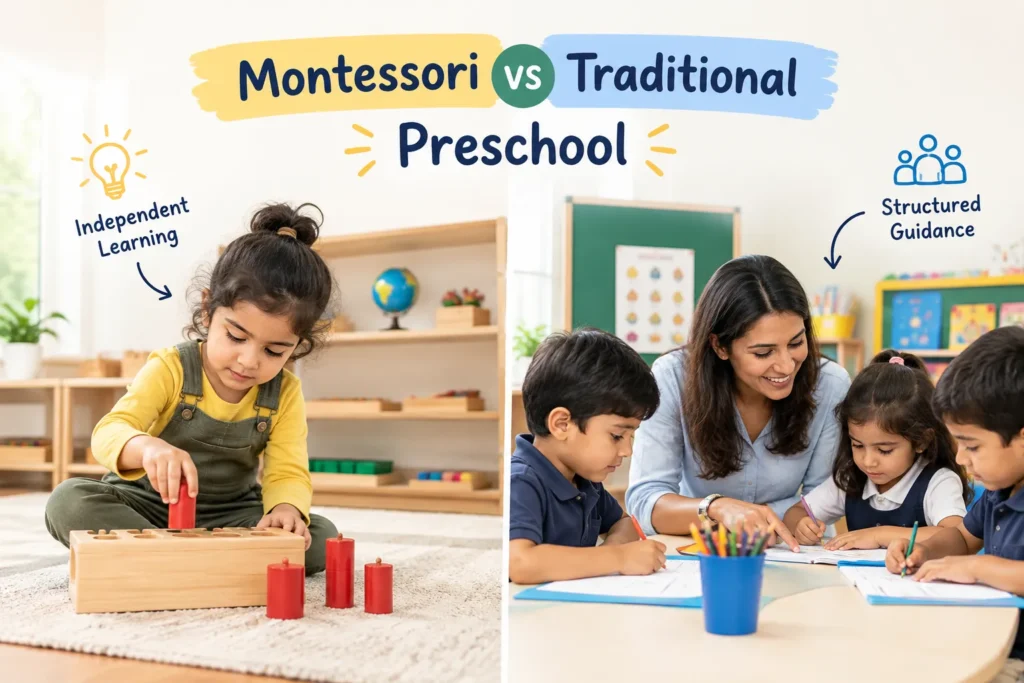
Key Differences between Montessori vs Traditional Preschool – 2026
Choosing a preschool can feel surprisingly complicated. One school talks about independence and self-directed learning. Another highlights a structured timetable, group activities and school readiness. Both may promise a happy, stimulating childhood. So how do you compare them fairly?
The question becomes especially common when parents search for Montessori school vs preschool. There is an important point to clear up first: Montessori is itself a type of early childhood educational approach, while ‘preschool’ is a broad term for an educational setting for young children. In practice, people often use ‘preschool’ to mean a more traditional or play-based preschool when making this comparison.
That distinction matters because the choice is not really between ‘Montessori’ and ‘education’. It is between different ways of organising the child’s day, classroom, learning materials, teacher role and opportunities for independence.
The American Montessori Society (AMS) describes Montessori as an approach that supports the whole child and commonly includes multi-age classrooms, child-directed work, specially designed materials and teachers who guide and observe children.
At the same time, research should keep the discussion grounded. A 2023 systematic review published through the Campbell Collaboration found positive effects of Montessori education on academic and non-academic outcomes compared with traditional education, but the evidence base includes variation in settings and implementation. A 2026 meta-analytic and metascientific review found positive pooled effects but also substantial heterogeneity, small-study effects and publication-bias concerns. In other words, Montessori can work well, but the label alone is not a guarantee of quality.
This guide explains the differences in plain language so parents can make a decision based on their child’s needs, not on marketing language.
Montessori School vs Preschool: The Quick Answer
The simplest distinction is this: a Montessori classroom generally gives children more choice within a carefully prepared environment, while a traditional preschool usually gives the teacher more control over the sequence and timing of group activities.
A Montessori setting may have mixed-age groups, accessible shelves, specialised hands-on materials, individual or small-group lessons and longer periods in which children can choose and complete activities. A traditional preschool may have a more uniform schedule, whole-group teaching, planned rotations, theme-based activities and more teacher-directed transitions.
Neither model is automatically better. A child who thrives with choice, repetition and independence may enjoy Montessori. Another child may benefit from the predictable rhythm and social structure of a more teacher-led programme. Many excellent preschools also blend approaches.
The most useful comparison is therefore not ‘Which philosophy wins?’ It is ‘Which environment is a good fit for this child, and how well does this particular school implement its approach?’
What Is Montessori Education?
Montessori education was developed by Italian physician and educator Dr Maria Montessori in the early twentieth century. Its central ideas include respect for children’s developing independence, learning through hands-on activity, a prepared environment and observation-based teaching.
According to the American Montessori Society’s overview of Montessori, Montessori classrooms typically use multi-age groupings, child-directed work, specialised materials and teachers who act as guides and mentors.
The classroom is designed so that children can access many materials themselves. Furniture is child-sized, shelves are arranged at an accessible height, and activities are usually presented in an orderly sequence. The environment is intended to make independence possible rather than simply asking children to be independent.
Montessori also gives unusual importance to practical activities. Children may pour water, prepare food, wash a table, care for plants, arrange materials or practise personal-care routines. These activities are not treated as meaningless chores. They are intended to build coordination, concentration, order and independence.
The American Montessori Society’s Early Childhood guidance identifies five broad areas in the early childhood classroom: Practical Life, Sensorial, Math, Language and Cultural Studies.
What Is a Traditional Preschool?
‘Traditional preschool’ is not a single official educational model. It is a broad description commonly used when contrasting Montessori with preschools that rely more heavily on teacher-planned activities, group routines and age-based classes.
A typical programme might include circle time, songs, stories, art, craft, outdoor play, early literacy and numeracy activities, pretend play, free-choice centres and teacher-led group projects. The balance varies considerably from one school to another.
This is important because not every non-Montessori preschool is worksheet-heavy or rigid. Many conventional preschools are strongly play-based and use child-centred practices. The real difference often lies in how much choice children have, how the day is organised and how teachers introduce learning.
The National Curriculum Framework for the Foundational Stage (NCF-FS) also supports play, activity, discovery and inquiry as important modes of learning for young children. That means an Indian preschool can be non-Montessori while still being developmentally appropriate and play-based.
Montessori School vs Preschool: Key Differences
| Area | Montessori approach | Traditional preschool approach |
| Teacher’s role | Guide, observer and presenter of individual or small-group lessons | Often leads group activities and manages the shared sequence |
| Child’s role | Chooses from available work within clear boundaries | Usually follows teacher-planned activities, with varying amounts of choice |
| Classroom | Prepared, orderly environment with accessible materials | Often activity areas, displays, group spaces and teacher-planned stations |
| Age grouping | Typically multi-age, often a three-year span | Usually grouped more closely by age |
| Learning materials | Specially designed Montessori materials with defined purposes | Broader mix of toys, books, art materials, manipulatives and classroom resources |
| Daily rhythm | Longer uninterrupted work periods are common | More frequent transitions between planned activities are common |
| Practical life | Central part of the curriculum | May be included, but usually not as a defining curriculum area |
| Assessment | Observation and tracking of individual progress are central | Methods vary from observation and portfolios to school-designed assessments |
| Learning pace | Children may repeat activities and progress according to readiness | Pacing is often more closely connected to the class plan |
1. Teaching Style: Guide vs Group Leader
One of the clearest differences appears in the teacher’s role. In Montessori, the teacher is generally described as a guide. Rather than talking to the whole class for most of the day, the teacher observes children, introduces materials and provides individual or small-group lessons.
The American Montessori Society’s core components identifies trained Montessori teachers as one of the essential components of high-quality Montessori implementation. The teacher’s preparation matters because the method depends heavily on careful observation and knowing when to present, step back or intervene.
In a traditional preschool, the teacher may take a more visibly leading role. They might gather the class for a story, demonstrate an activity, organise a craft or lead a group game. That can create a strong shared rhythm and may suit children who enjoy group interaction.
Neither role is automatically superior. What matters is whether the teacher is responsive, knowledgeable and able to engage children meaningfully.
2. Child Choice and Independence
Montessori gives children considerable choice, but it is not unlimited freedom. The environment contains selected activities, lessons have boundaries, and children are expected to use materials appropriately and return them when finished.
The AMS describes child-directed work as a core component and notes that children select work while developing agency, concentration and responsibility.
Traditional preschools may also provide choice, particularly during free play or learning centres, but the teacher usually determines more of the daily sequence. For example, everyone might move from circle time to an art activity and then outdoors together.
For some children, that predictable group structure feels reassuring. Others may become deeply absorbed when given more time to repeat an activity without being asked to move on.
3. Classroom Environment
A Montessori room is deliberately prepared around children’s ability to work independently. Open shelves, child-sized furniture, clearly arranged materials and accessible practical-life stations are common features.
AMS describes the prepared environment as carefully arranged with materials presented sequentially to meet developmental needs. The classroom is designed to support focused individual or small-group work.
A traditional preschool classroom can look much more varied. It may contain themed displays, dramatic-play corners, books, blocks, craft supplies, tables for group work and teacher-created learning stations. Some rooms are visually busy; others are calm and minimalist.
The important question during a school visit is not whether the room ‘looks Montessori’. Ask whether the environment helps children find materials, make choices, participate safely and stay engaged.
4. Age Grouping
Mixed-age classrooms are a defining Montessori feature. AMS describes Montessori classes as commonly spanning around three years, allowing younger children to learn from older classmates while older children have opportunities to model skills and take responsibility.
Traditional preschools more commonly group children by age, such as nursery, junior kindergarten and senior kindergarten, although the exact structure varies by school and country.
Multi-age grouping can support peer learning, but it also requires skilled classroom management. Age-based grouping can make planning and progression simpler, but it may offer fewer opportunities for children of different ages to learn together.
If you are comparing schools, ask how the classroom grouping works in practice rather than assuming that one arrangement will automatically suit your child.
5. Learning Materials
Montessori materials are one of the approach’s most recognisable features. Many are designed to isolate a particular concept or quality, such as size, shape, sound, quantity or letter formation.
The AMS explanation of Montessori materials describes them as specially designed, hands-on materials. Children often receive presentations showing how to use a material and then practise independently.
Traditional preschools generally use a wider mix of resources. These may include storybooks, puzzles, blocks, crayons, paint, playdough, construction sets, dramatic-play props, counting objects and teacher-created resources.
The difference is not simply ‘special materials versus ordinary toys’. Montessori materials tend to have a specific pedagogical purpose and sequence, while traditional preschool resources may be more open-ended and varied.
6. Learning Through Play
This is where the comparison can become misleading. Montessori is sometimes described as ‘not play-based’, while traditional preschool is described as play-based. The reality is more nuanced.
Montessori includes purposeful hands-on activity, exploration and practical-life work, but classic Montessori terminology often refers to children’s activities as ‘work’. Traditional preschools may give more explicit space to pretend play, dramatic play, open-ended construction and teacher-led games.
India’s NCF-FS recognises play as a central mode of learning and includes both child-directed and teacher-supported forms of play. It also discusses Montessori among the thinkers who influenced early childhood education.
Parents should therefore ask what children actually do for most of the day. A school can use the word ‘play’ heavily in its brochure and still offer little genuine choice. Another can use Montessori language while providing a rich, engaging learning environment.
7. Practical Life and Everyday Skills
Practical Life is one of the clearest Montessori distinctions. Children may wash hands, pour water, prepare a snack, sweep, arrange flowers, care for plants or clean a work area.
AMS explains that these activities are intended to support independence, concentration, coordination and care for self and the environment. The AMS discussion of Practical Life explains how everyday tasks can serve as indirect preparation for later academic work.
Traditional preschools may teach similar life skills, but they are less likely to make them a dedicated, defining curriculum area. Children may tidy toys, help distribute materials or practise self-care, but the activities may not be organised into a formal Practical Life sequence.
For parents, this can be a useful deciding factor. If you want a school that deliberately builds independence through everyday tasks, Montessori may be particularly appealing.
8. Academic Learning: Which Starts Earlier?
A common misconception is that Montessori means ‘no academics’. That is not accurate. Montessori early childhood classrooms can introduce language and mathematics through carefully sequenced hands-on materials.
AMS lists Language and Math among the core early childhood curriculum areas. Children may work with quantities, symbols, sounds, letters and writing materials as they show readiness.
Traditional preschools may also introduce letters, phonics, numbers and early writing, often through group lessons, songs, stories, worksheets, games and teacher-guided activities.
The more useful question is not which model starts academics earlier. It is whether the approach builds genuine understanding without putting inappropriate pressure on young children.
9. Pace and Repetition
Young children often need repetition. A child may want to pour water ten times, complete the same puzzle repeatedly or read the same story every day. Montessori environments are designed to allow considerable repetition and concentration during uninterrupted work periods.
AMS describes work cycles that can give children extended time to choose, complete and repeat activities. The intention is to support concentration, coordination, independence and mastery.
Traditional preschools may have shorter activity blocks because the whole class moves through a shared timetable. This can provide variety and predictability, but it may also interrupt a child’s concentration when it is time to move to the next activity.
Neither rhythm is inherently right for every child. Watch how your child handles transitions and whether they tend to thrive on variety or become deeply absorbed in repeated activities.
10. Social Development and Peer Interaction
Both approaches can support social development, but the social experience may look different. Montessori children often work independently alongside peers, with opportunities to observe, collaborate and help younger classmates.
Traditional preschool may create more whole-group interaction through circle time, group games, collaborative crafts, songs and teacher-led discussions.
A quiet Montessori room is not necessarily less social. Children can communicate, negotiate, offer help and participate in a community while working on different activities. Conversely, a lively traditional classroom can still provide plenty of independent choice.
Look at how children actually interact rather than judging the atmosphere from volume alone.
What Does Research Say About Montessori Education?
Research on Montessori is encouraging, but responsible advice should avoid presenting it as a magic formula. The evidence depends on the quality of the studies and, importantly, on whether a programme actually implements Montessori principles with fidelity.
The 2023 Campbell systematic review examined 32 studies comparing Montessori with traditional education after applying criteria intended to establish baseline equivalence. Across the included evidence, Montessori showed positive effects on academic and non-academic outcomes.
A separate 2023 meta-analysis in Contemporary Educational Psychology included 33 experimental or quasi-experimental studies and reported positive effects across five fields of development and learning.
However, the newest evidence adds an important qualification. A 2026 preregistered meta-analytic and metascientific review identified positive pooled effects but also substantial heterogeneity, small-study effects and indications of publication bias. This means the overall direction is promising, but the size and certainty of benefits should not be overstated.
The practical takeaway is reassuring: parents do not need to choose Montessori because they believe it guarantees higher intelligence or academic results. Choose it if the approach, teachers and environment are a good fit for your child.
Is Montessori Better Than Traditional Preschool?
There is no honest one-word answer. Montessori can be an excellent choice, and a high-quality traditional preschool can be an excellent choice too.
A school with a famous philosophy can still be poorly implemented. Likewise, a school without a Montessori label can have thoughtful teachers, rich play experiences, strong relationships and developmentally appropriate learning.
The American Montessori Society itself identifies trained teachers, a prepared environment, multi-age classrooms, Montessori materials and child-directed work as core components. That is a useful reminder that authentic implementation involves much more than putting wooden materials on shelves.
For parents, the school visit matters more than the marketing copy. Watch a classroom, ask questions and speak to the teachers who will actually work with your child.
Which Children May Enjoy Montessori?
- Children who enjoy choosing activities and working independently.
- Children who can become absorbed in an activity and appreciate repetition.
- Children who respond well to calm, orderly environments.
- Children who enjoy practical tasks and doing things for themselves.
- Children who benefit from learning at an individual pace within clear boundaries.
- Children who enjoy observing and learning from older or younger peers.
Which Children May Prefer a Traditional Preschool?
- Children who enjoy frequent group activities and shared routines.
- Children who respond positively to songs, stories, dramatic play and teacher-led games.
- Children who enjoy variety and frequent changes between activities.
- Children who thrive when an adult provides a clear sequence for the day.
- Children who enjoy open-ended toys, imaginative play and collaborative projects.
- Children who benefit from a classroom model that closely mirrors the structure of their future school.
Montessori in the Indian Preschool Context
Indian parents should consider one additional factor: Montessori is a particular educational philosophy, while India’s national early childhood framework is broader. A school can use Montessori principles alongside the expectations of the Indian education system.
The NCF-FS 2022 covers the Foundational Stage from age 3 to 8 and emphasises play, activity, discovery, inquiry and development across multiple domains. It specifically recognises Montessori as one of the important influences on early childhood education.
This means parents should ask an Indian Montessori school how its Montessori curriculum connects with the board, foundational-stage expectations and the child’s eventual transition into formal schooling.
The Montessori Institute of Bangalore is one example of an organisation focused on Montessori teacher preparation and AMI-aligned practice in India. Its information also illustrates an important point: Montessori training is specialised and different age groups require different preparation.
Do not assume that every school using the word ‘Montessori’ follows the same model. Ask about teacher training, classroom age range, daily work cycle, materials, assessment and curriculum progression.
How to Spot an Authentic Montessori Environment
Trained Montessori educators
Ask what Montessori training teachers have completed and which age group their training covers.
Multi-age classroom
Find out whether children are grouped across a developmental span and how peer learning is supported.
Prepared environment
Look for accessible shelves, child-sized furniture and materials arranged with purpose.
Montessori materials
Ask whether the classroom uses genuine or thoughtfully adapted Montessori materials and how teachers present them.
Child-directed work
Children should have meaningful choices within clear classroom boundaries.
Observation
Teachers should be able to explain how they observe children and use those observations to guide lessons.
Work cycle
Ask how long children can stay engaged with an activity without unnecessary interruption.
Questions to Ask Before Choosing a Preschool
- What does a normal day look like from arrival to pick-up?
- How much of the day is child-chosen activity and how much is teacher-led?
- How are reading, writing and mathematics introduced?
- How are children supported when they struggle with an activity?
- What qualifications or Montessori training do the teachers have?
- How does the school handle conflict between children?
- How are children’s progress and development documented?
- How does the school communicate progress with parents?
- How much outdoor time and physical movement do children receive?
- How does the programme prepare children for the next stage of education?
Red Flags to Watch For
The label does all the talking
If a school says ‘Montessori’ but cannot explain teacher training, classroom structure or the method behind its materials, ask more questions.
Too much worksheet time
Regardless of philosophy, a preschool that relies heavily on repetitive worksheets may not be giving children enough movement, conversation, exploration and hands-on learning.
No room for individual needs
A child-centred approach should still respond to children who need additional support or a different pace.
No meaningful outdoor activity
Young children need physical movement and opportunities to engage with their surroundings.
Teachers cannot explain progress
Good educators should be able to tell parents what children are learning and how observations inform next steps.
Rigid claims about superiority
Be cautious of any school that promises its philosophy is universally better for every child.
Montessori vs Traditional Preschool: A Parent Decision Checklist
Before making a final decision, score each school against the things that actually matter to your family. You can use a simple 1-to-5 scale for each item.
- Teacher quality and warmth
- Child safety and supervision
- Fit with your child’s temperament
- Balance of independence and guidance
- Quality of classroom materials
- Time for play and physical movement
- Language and early literacy support
- Early mathematical development
- Social and emotional support
- Communication with parents
- Practical location and daily routine
- Affordability and overall value
This approach is often more useful than trying to identify a universal winner. The best preschool is the one where the educational approach, people and environment work together to support your child.
Frequently Asked Questions
What is the difference between Montessori school and preschool?
Montessori is a specific educational approach, while preschool is a broad term for early childhood education. When people compare them, they usually mean Montessori versus a more traditional or play-based preschool. Montessori generally places greater emphasis on prepared environments, child-directed work, mixed ages and specialised materials.
Is Montessori better than traditional preschool?
Not universally. Research suggests Montessori can have positive academic and non-academic effects, but outcomes depend on implementation and context. A high-quality traditional preschool can also provide excellent early learning.
Is Montessori play-based?
Montessori includes hands-on exploration and purposeful activity, but classic Montessori often calls children’s activities ‘work’ rather than play. Traditional play-based preschools may provide more pretend play and open-ended group play. Both can support learning.
What age is Montessori preschool for?
Montessori programmes vary. AMS describes its Early Childhood programmes as generally serving children from about 2.5 to 6 years, while some Montessori schools organise classrooms differently. Check the specific school’s age range.
Do Montessori schools teach reading and maths?
Yes. Montessori Early Childhood classrooms commonly include Language and Math areas. Learning is introduced through hands-on, sequential materials and individual or small-group lessons.
Are Montessori classrooms always mixed age?
Multi-age grouping is a core Montessori component. A typical Montessori early childhood classroom spans roughly three years, although exact arrangements vary by school.
Is Montessori suitable for every child?
No educational approach is ideal for every child. Montessori may suit children who enjoy independence, repetition and calm, orderly environments, while some children may prefer more group-led activities and frequent transitions.
How should parents choose between Montessori and traditional preschool?
Visit the actual classroom, observe teacher-child interactions, ask about teacher training and curriculum, and consider your child’s temperament, learning preferences, needs and future transition. The quality of implementation matters more than the label alone.
Conclusion
When comparing Montessori school vs preschool, the most important thing is to look past the labels. Montessori is a distinct educational philosophy built around a prepared environment, independence, hands-on materials, mixed-age learning and a teacher who guides rather than constantly directs. Traditional preschools vary much more widely, but often provide stronger whole-group structure, planned activities and frequent social routines.
Neither approach should be treated as a shortcut to guaranteed success. Research on Montessori is broadly encouraging, yet recent reviews also show why claims should be kept realistic. The quality of implementation, teacher preparation, classroom environment and fit with the individual child all matter.
For parents in India, the choice should also be viewed alongside the country’s Foundational Stage framework. A good preschool should support language, early numeracy, physical development, social-emotional growth, creativity, curiosity and independence, while giving children an age-appropriate route into later schooling.
If possible, visit the school before deciding. Watch how teachers speak to children. Notice whether children are engaged rather than merely quiet. Look at the materials they can access. Ask what happens when a child struggles, loses interest or needs more time. Those small details often tell you more than a brochure ever will.
Ultimately, the best preschool is not the one with the most impressive philosophy. It is the one where your child feels safe, respected, curious and capable of learning. Montessori can provide that environment, and so can a well-designed traditional preschool. The right choice is the one that turns those principles into a genuinely good everyday experience for your child.