
Key Differences between Montessori vs Traditional Preschool – 2026
September 18, 2026
Elementary Education Goals & Facts – Complete Guide 2026
September 21, 2026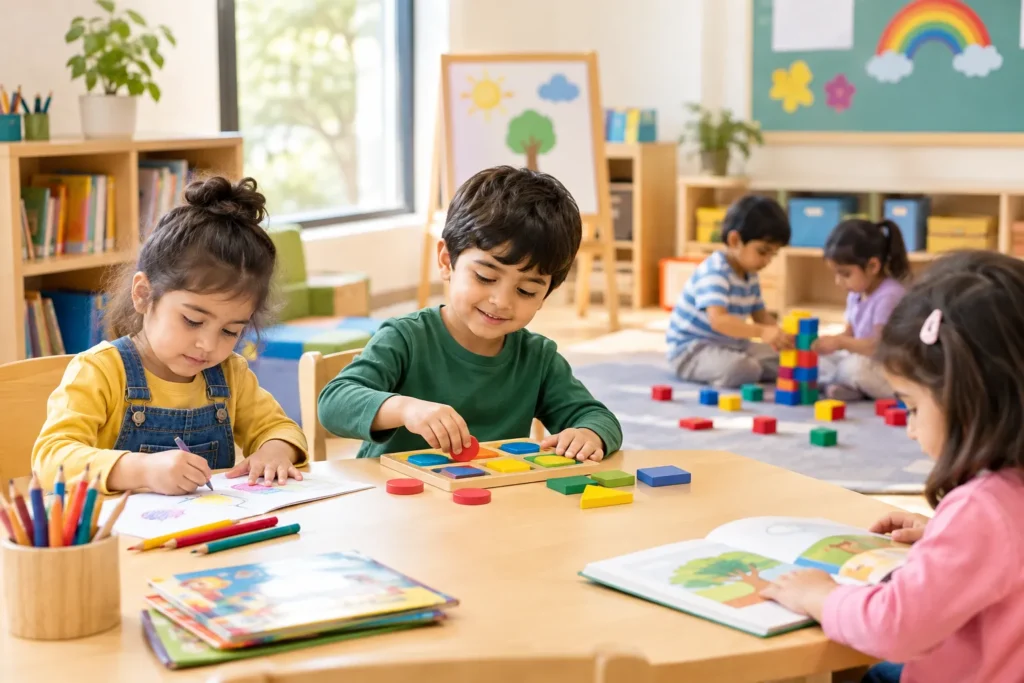
What is Pre-Primary Education ?Age Criteria, Importance and Benefits – 2026 Edition
If you have searched to understand what pre primary means, you are likely a parent standing at the very first fork in your child’s education journey. It is one of the most common questions new parents ask, and rightly so.
In plain terms, pre-primary education is the stage of structured, play-based learning a child goes through before joining Class 1. It sits between the toddler years and formal schooling, and it plays a bigger role in a child’s future than many parents realise.
This guide explains what pre primary means in the Indian context, the age criteria involved, the curriculum children follow, and how the National Education Policy 2020 has reshaped this stage. Short sections and a simple table make it easy to save and revisit.
Quick answer: Pre-primary education refers to the structured, play-based learning children receive before Class 1, generally between the ages of 3 and 6. It includes playgroup, nursery, LKG, and UKG, and focuses on social, emotional, physical, and early academic readiness rather than formal exams.
What Does Pre-Primary Mean?
The word “pre-primary” simply means before primary. So when parents ask what pre primary means, the short answer is that it is the stage of education that comes before Class 1, which is where primary school formally begins.
Pre-primary education is also called early childhood education or preschool education in everyday conversation. In India, it goes by several names depending on the institution, including Anganwadi, Balwadi, nursery school, kindergarten, and Montessori.
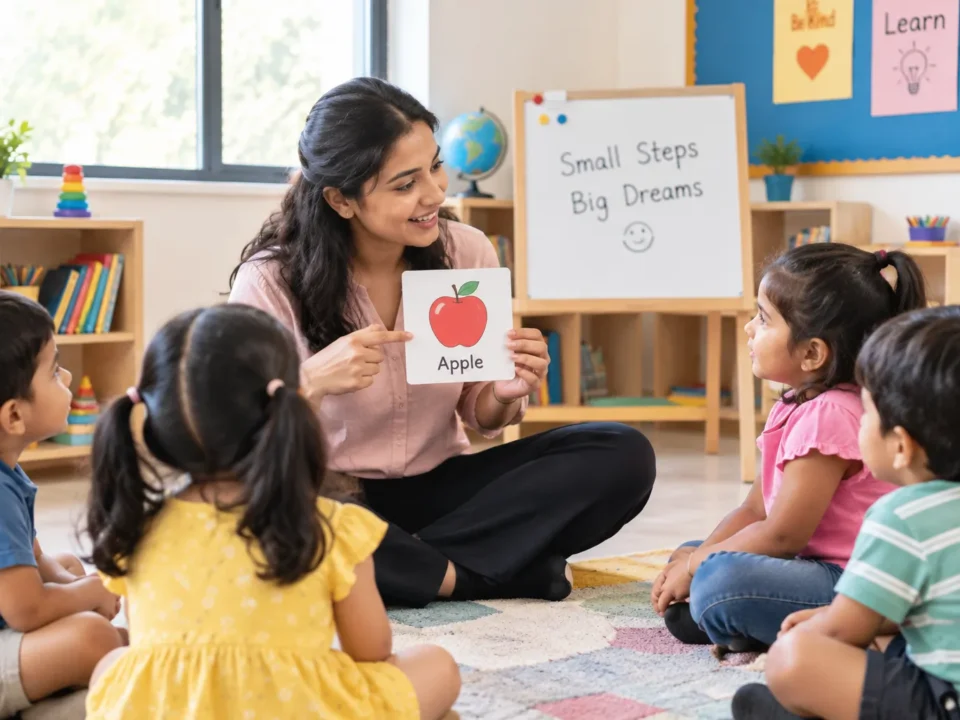
Unlike primary school, pre-primary classes do not follow strict textbooks or written examinations. Learning happens through stories, songs, play, and guided activity, matching how young children naturally absorb new information.
It is also worth noting that pre-primary education is not legally the same thing as formal schooling in India. It sits in a slightly different regulatory space, which is why standards and quality can vary more widely between institutions than they do at the primary level.
Age Criteria for Pre-Primary Education
One of the most practical questions parents have is which class suits which age. The table below sets out the general age criteria followed by most pre-primary education institutions in India.
| Class / Level | Typical Age | Common Names Used |
|---|---|---|
| Playgroup | 1.5 to 2.5 years | Playgroup, Pre-Nursery |
| Nursery | 3 to 4 years | Nursery, Junior KG |
| LKG | 4 to 5 years | Lower Kindergarten, Senior KG |
| UKG | 5 to 6 years | Upper Kindergarten, Prep |
These age brackets are indicative rather than fixed. Exact cut-off dates for admission vary between states, school boards, and individual institutions, so it is always worth checking directly with a shortlisted school.
Most children complete this full four-stage journey, from playgroup through UKG, by the time they turn six, at which point they typically move into Class 1 of primary school.
Some families choose to skip playgroups entirely and begin directly with nursery, which is completely normal. There is no single correct starting point, and readiness matters more than following every stage in sequence.
Pre-Primary Education Under NEP 2020 and the Foundational Stage
The National Education Policy (NEP) 2020 was the first national policy to formally bring pre-primary education into the mainstream school system, rather than treating it as a separate, informal stage.
Under the new 5+3+3+4 structure, the first five years are called the Foundational Stage. This covers three years of pre-primary learning, delivered through Anganwadi centres or pre-schools, followed by Class 1 and Class 2.
This means pre-primary education is no longer viewed as “just playtime” before school. It is officially recognised as the first academic stage of a child’s schooling journey, with its own curriculum framework and learning goals.
The National Curriculum Framework for the Foundational Stage, 2022, released by the NCERT, guides how this stage is taught, moving away from textbooks toward toys, story cards, puppets, and guided play.
At the national level, the Samagra Shiksha scheme run by the Ministry of Education now formally supports pre-school education as one of its core components, alongside primary and secondary schooling.
This scheme also recognises that pre-schools in India go by many different names, including Anganwadis, Balwadis, nursery schools, preparatory classes, and Balvatikas, and treats them all as part of the same continuum leading into formal schooling.
Government vs Private Pre-Primary Schools in India
Parents exploring pre-primary education usually choose between government-run Anganwadi centres and private nursery or kindergarten schools, each suited to different needs and budgets.
- Anganwadi centres: free, government-run, combine early learning with nutrition and health tracking, widely available even in rural areas
- Private nursery and kindergarten schools: fee-based, often with smaller class sizes and more structured facilities, more common in urban areas
Neither option is automatically superior. A well-run Anganwadi with a trained worker can offer excellent early stimulation, while some private pre-schools focus more on branding than genuine developmental quality, so it always pays to visit and observe before deciding.
Curriculum: What Is Taught in Pre-Primary Education
A common myth is that pre-primary education has no real curriculum. In practice, most quality pre-schools follow a structured, age-appropriate plan built around holistic development rather than rote academics.
- Language and early literacy through rhymes, stories, and picture recognition
- Early numeracy through counting, shapes, colours, and simple sorting activities
- Environmental awareness, covering plants, animals, weather, and daily surroundings
- Art, craft, music, and movement to build creativity and fine motor skills
- Social and emotional skills, including sharing, turn-taking, and following simple routines
- Physical development through outdoor play, dance, and basic motor activities
Assessment at this stage relies on observation rather than written tests. Teachers typically track a child’s progress through simple checklists and portfolios rather than marks or grades.
Many pre-schools also introduce a second language during this stage, alongside the child’s home language. Research generally supports this approach, since young children absorb multiple languages more naturally than older learners, provided the exposure stays playful rather than test-driven.
Types of Pre-Primary Institutions in India
When people search for what pre primary means, they often also want to know the difference between the various types of institutions offering it. Each follows a slightly different philosophy.
- Anganwadi centres: government-run centres that combine early learning with nutrition and health services under the ICDS scheme
- Balwadi: community-based pre-schools, often run by NGOs, focused on play-based early learning for children aged 3 to 5
- Nursery and kindergarten schools: private institutions following structured playgroup to UKG classes, often attached to a larger school
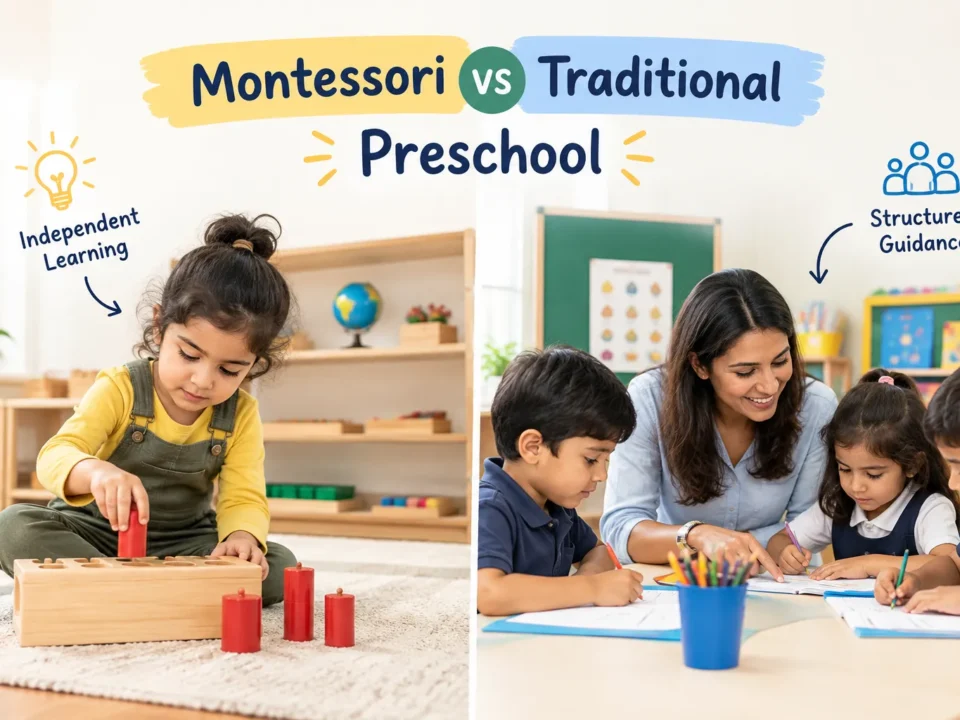
- Montessori schools: follow a child-led, self-directed learning approach with specially designed materials
None of these approaches is universally “better.” The right choice depends on a child’s temperament, family priorities, and what is realistically accessible in a given area.
Many schools also blend elements from more than one approach, borrowing Montessori materials alongside a broader play-based curriculum, so it is worth asking a school directly about its specific teaching philosophy rather than relying on the label alone.
The Importance of Play-Based Learning in Pre-Primary Education
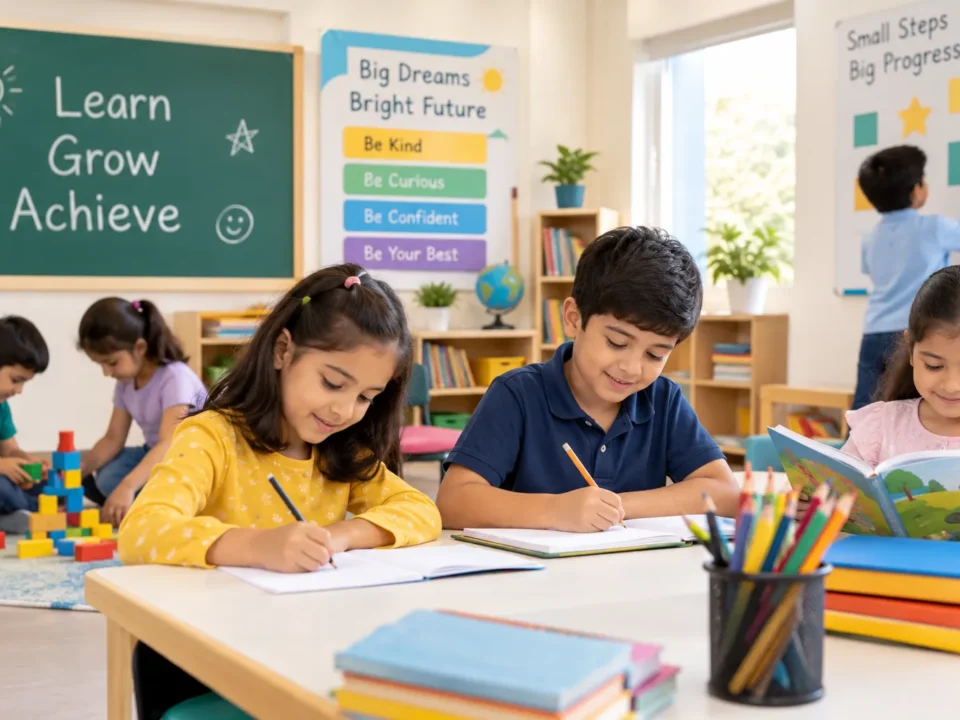
Play is not a break from learning during the pre-primary education years. For children this age, it is the primary method through which real learning actually happens.
Through pretend play, a child practises language, negotiation, planning, and problem-solving all at once, often without realising they are learning anything at all.
Building blocks teach early maths concepts such as balance, size, and counting. Pretend kitchen play builds vocabulary and sequencing. Simple group games teach turn-taking and following rules, all through enjoyable, low-pressure activity.
The National Curriculum Framework for the Foundational Stage explicitly recommends this play-based and activity-based pedagogy for children aged three to eight, moving away from textbook-driven instruction that does not suit this age group.
Benefits of Pre-Primary Education
Quality pre-primary education offers benefits that extend well beyond the pre-school years themselves. It shapes how confidently and smoothly a child transitions into formal schooling.
- Builds early language and communication skills through daily interaction
- Develops fine and gross motor skills needed for writing and physical activity
- Encourages social skills such as sharing, cooperation, and empathy
- Builds independence, since children learn basic self-care and classroom routines
- Reduces anxiety around starting primary school, since children are already used to a classroom setting
Children who go through structured pre-primary education generally find it easier to settle into Class 1, since the transition feels like a natural next step rather than a completely new experience.
Beyond academics, pre-primary years also shape a child’s early attitude toward learning itself. Children who experience warm, encouraging early classrooms often carry that positive association with school forward into later grades.
Skills to Look for Before a Child Moves to Primary School
Parents often wonder whether their child has gained enough from pre-primary education to move confidently into Class 1. A few general signs can help, though every child develops at their own pace.
- Can follow two or three simple instructions in sequence
- Shows interest in letters, numbers, or picture books
- Can separate from a parent for a few hours without prolonged distress
- Plays cooperatively with other children for short stretches of time
- Manages basic self-care tasks, such as washing hands or eating independently
These are general guides rather than strict benchmarks. A pre-primary teacher is usually the best judge of whether a child is ready, since they observe the child across many everyday situations.
Legal Backing: RTE Act and Pre-School Provisions
Pre-primary schooling in India also has a legal foundation. The Right of Children to Free and Compulsory Education Act, 2009 specifically mentions the state’s responsibility to provide early childhood care and education for children until the age of six.
While the RTE Act’s core legal guarantee of free and compulsory education applies from age six onward, this provision recognises pre-primary education as an essential precursor that governments should support and expand.
Building on this, the Samagra Shiksha scheme now channels central funding specifically toward strengthening pre-school education in government schools, treating it as part of one continuous school journey rather than a separate phase.
Together, these provisions signal a broader policy shift in India, treating the years before Class 1 as a genuine entitlement worth investing in, rather than a private, optional add-on left entirely to individual families.
Pre-Primary Education vs Primary Education
Parents sometimes assume pre-primary classes are simply an easier version of primary school. In reality, the two stages are built on very different principles and goals.
- Pre-primary education: play-based, flexible routines, observation-based assessment, focus on holistic development, ages 3 to 6
- Primary education: subject-based timetables, structured lessons, written assessments, focus on academic progression, ages 6 to 11
Understanding this difference helps parents avoid pushing formal, textbook-style learning too early, which research suggests offers little long-term academic advantage and can create unnecessary pressure on young children.
Transitioning smoothly between the two stages usually works best when schools deliberately bridge the gap, gradually introducing longer sitting periods, simple worksheets, and slightly more structured routines toward the end of UKG.
A Typical Day in Pre-Primary School
Most pre-primary education settings in India run for around two to four hours a day, considerably shorter than a primary school schedule, to match a young child’s attention span.
A typical day includes a welcome circle time, a mix of language and numeracy activities, a snack or play break, art or music time, and outdoor or free play before the day ends.
Naptime is often built into full-day daycare-style pre-schools, particularly for younger children in the playgroup and nursery age group.
Most sessions end with a short recap or a goodbye circle, giving children a sense of closure and routine, which research suggests helps young children feel more secure about returning the next day.
How to Choose the Right Pre-Primary School
Selecting a pre-primary education provider is one of the first big parenting decisions, and it helps to have a clear checklist rather than relying on brochures alone.
- Observe a class in session: watch whether children are actively engaged through play rather than seated for long, passive periods.
- Check the teacher-to-child ratio: smaller groups generally allow more individual attention at this age.
- Ask about the curriculum approach: look for play-based and activity-based methods rather than heavy worksheet use.
- Assess safety and hygiene standards: clean toilets, safe play equipment, and clear pick-up and drop-off procedures matter greatly.
- Check staff qualifications: teachers trained in early childhood development tend to respond better to individual needs.
- Talk to current parents: honest, first-hand feedback often reveals details a website or brochure will not.
The Role of Parents in Pre-Primary Learning
No pre-primary education programme can fully replace the influence of home. Parents remain a child’s first and most consistent teachers during these years.
Simple daily habits such as reading aloud, singing together, encouraging pretend play, and talking through everyday routines all reinforce what a child learns in the classroom.
Staying in regular contact with a child’s teacher also helps parents understand what is being covered in class and how best to support it at home, without adding pressure or turning every moment into a lesson.
It also helps to resist comparing one child’s pace to another’s. Development during pre-primary education follows a wide, normal range, and gentle encouragement tends to work far better than pressure or comparison with siblings or classmates.
Common Challenges in Pre-Primary Education in India
Despite growing policy attention, pre-primary education in India still faces real gaps, particularly in rural and low-income areas.
Many Anganwadi centres continue to struggle with shortages of trained staff, learning materials, and adequate infrastructure, which affects the consistency of care a child receives.
According to a review published by Accountability Initiative, pre-primary education did not receive a dedicated national policy push until the launch of Samagra Shiksha funding in 2018 to 2019, meaning implementation is still catching up across many states.
Teacher training gaps remain a particular concern, since early childhood pedagogy requires a very different skill set from teaching older children, and not every pre-primary educator receives specialised training in this area.
Awareness gaps also play a role, since some families continue to view pre-primary years mainly as childcare rather than a genuine, structured stage of learning.
Affordability remains another barrier for many families, since quality private pre-schools can be expensive in urban areas, while free government provisions are not always accessible or well staffed in every neighbourhood.
Efforts to co-locate Anganwadi centres with primary schools, along with wider rollout of the National Curriculum Framework for the Foundational Stage, are gradually helping to narrow these gaps across several states.
Frequently Asked Questions
What does pre-primary mean in simple words?
Pre-primary means the stage of education that comes before primary school, generally covering ages 3 to 6, focused on play-based learning rather than formal exams.
What is the right age to start pre-primary education?
Most children begin some form of pre-primary education, such as playgroup or nursery, between the ages of 2 and 3, though this varies by family and by school.
Is pre-primary education compulsory in India?
Pre-primary education is not legally compulsory in the same way elementary education is, though the Right to Education Act does call on the government to support and expand access to it.
What is the difference between nursery, LKG, and UKG?
Nursery generally suits children aged 3 to 4, LKG suits children aged 4 to 5, and UKG suits children aged 5 to 6, with each stage gradually building on the skills developed in the one before it.
Does pre-primary education include exams?
No. Most pre-primary classes use observation-based assessment, such as teacher checklists and portfolios, rather than formal written exams.
What comes after pre-primary education?
After completing UKG, children typically move into Class 1, which marks the start of primary education and a more structured academic routine.
Can a child skip pre-primary education and go straight to Class 1?
Some schools do allow direct admission to Class 1 without prior pre-primary schooling, though children without this exposure may need extra support adjusting to classroom routines and early social skills.
Is play-based learning as effective as academic learning at this age?
Yes. For children under six, research consistently shows that play-based learning builds language, reasoning, and social skills more effectively than early formal academic instruction.
How long should a pre-primary school day be?
Most pre-primary sessions run between two and four hours a day, which matches the attention span typical of children in this age group and avoids overtiring them.
Do pre-primary schools follow a fixed national curriculum?
Not in the same way primary and secondary schools do. Pre-primary institutions generally follow guidance from frameworks such as the NCF for the Foundational Stage, but individual schools have flexibility in how they structure daily activities.
Conclusion
So, what does pre primary mean? It is the foundational stage of a child’s education, generally covering ages 3 to 6, built around play, exploration, and gentle structure rather than formal academics. It prepares children socially, emotionally, and cognitively for the more structured years of primary school ahead.
Whether delivered through an Anganwadi centre, a neighbourhood nursery, or a Montessori setting, quality pre-primary education gives children a confident, well-rounded start. Choosing the right environment, staying involved as a parent, and understanding what this stage actually involves will always be time well spent.
As India continues to invest in early childhood learning through policies such as NEP 2020 and schemes like Samagra Shiksha, the years before Class 1 are steadily gaining the recognition they have always deserved.