
What is Elementary School
September 7, 2026
Every parent wants to give their child the best possible start, and this is exactly why early childhood learning has become such a widely searched topic. The years before a child turns eight shape far more than most people realise.
Early childhood education is not simply about getting a head start on the alphabet or counting numbers. It is about nurturing a child’s brain, body, emotions, and social skills at the exact stage when they are most receptive to growth.
This guide explains how early childhood learning supports every dimension of a child’s development, what the science says, how India’s education policy approaches this stage, and how parents can make informed choices. Short sections and one simple table keep things easy to scan and save.
Quick answer: Early childhood education refers to structured and play-based learning for children from birth to around eight years of age. It supports physical, cognitive, language, social, emotional, and creative development, building the foundation on which all later learning depends.
What Is Early Childhood Education?
Early childhood education, often shortened to ECE, covers the learning and care a child receives from birth through the early primary years. In India, this stage is formally referred to as Early Childhood Care and Education, or ECCE.
Unlike formal schooling, early childhood learning relies heavily on play, exploration, stories, songs, and hands-on activity rather than textbooks and written tests. This approach matches how young children naturally absorb information.
The setting can vary widely, from Anganwadi centres and government pre-schools to private nurseries, playgroups, and home-based learning. What matters most is not the label on the building but the quality of interaction a child receives there.
Globally, the term early childhood education typically covers the period from birth to age eight, while in India the Anganwadi and ICDS network, run under the Ministry of Women and Child Development, has historically delivered much of this care alongside nutrition and health services.
It is worth noting that early childhood education is not the same as formal schooling. It relies on warmth, routine, and sensory exploration rather than exams, and success at this stage is measured through observation rather than marks.
Why Early Childhood Learning Matters: The Science of Brain Development
The case for early childhood education is not just opinion. It is backed by decades of research into how the human brain develops in the first years of life.
According to the National Education Policy 2020, over 85 per cent of a child’s cumulative brain development takes place before the age of six. This single statistic explains why the early years carry so much weight in shaping lifelong learning ability.
During this window, the brain forms neural connections at a remarkable pace, based directly on the experiences, conversations, and stimulation a child receives. Rich, warm, and responsive environments during this period tend to produce stronger long-term outcomes.
This is precisely why quality early childhood learning cannot be postponed until a child is older. Waiting until Class 1 to focus on development means missing the window when the brain is most receptive to building these foundations.
Neuroscience research also shows that stress and neglect during these years can slow this development, which is why calm, secure, and predictable environments matter just as much as structured activities.
None of this means parents need to turn every moment into a lesson. Consistent, warm interaction, even during ordinary daily routines such as mealtimes and baths, contributes meaningfully to healthy brain development.
Early Childhood Education in India: The ECCE Framework Under NEP 2020
India has taken a significant policy step by formally weaving early childhood education into the school system. The National Education Policy 2020 restructured schooling into a 5+3+3+4 model, with the first five years called the Foundational Stage.
This Foundational Stage combines three years of ECCE, delivered through Anganwadi centres, pre-schools, or Balvatika classes, with Class 1 and Class 2, treating all five years as one continuous learning journey rather than separate stages.
| Age Group | Setting | Focus Area |
|---|---|---|
| 3 to 6 years | Anganwadi / Pre-school / Balvatika | Play-based learning, early language, social skills |
| 6 to 7 years | Class 1 | Early literacy and numeracy, structured routines |
| 7 to 8 years | Class 2 | Consolidating foundational skills before Class 3 |
According to UNICEF India, the policy recommends four delivery models for this stage: community Anganwadi centres, Anganwadi centres co-located with schools, pre-primary sections within schools, and standalone pre-schools.
The National Curriculum Framework for the Foundational Stage, 2022, released by the NCERT, guides how this stage is taught, moving away from textbooks toward toys, story cards, puppets, and guided play.
The framework also introduces the idea of a Preparatory Class, or Balvatika, for children just before Class 1. This class is meant to smooth the transition from play-based Anganwadi learning to the more structured routine of primary school.
Several states have also begun co-locating Anganwadi centres with primary schools, so that a child can move seamlessly from ECCE into Class 1 without changing buildings, teachers, or routines all at once.
Nutrition, Health and Care Alongside Early Childhood Learning
Early childhood education in India has always been closely linked with nutrition and health, largely through the Integrated Child Development Services scheme delivered via Anganwadi centres.
A well-nourished child concentrates better, falls sick less often, and reaches physical milestones on schedule, all of which directly support classroom engagement and learning readiness.
Regular health check-ups, growth monitoring, and immunisation tracking offered through Anganwadi centres complement the learning side of ECCE, reflecting the fact that care and education cannot really be separated at this age.
The Five Key Domains of Development Supported by Early Childhood Education
Rather than focusing only on academics, quality early childhood learning is built around five interconnected domains of growth. Each one reinforces the others, which is why a good programme never isolates one skill at the cost of another.
- Physical development: gross and fine motor skills, coordination, and healthy habits
- Cognitive development: thinking, problem-solving, memory, and reasoning
- Language and literacy development: vocabulary, listening, speaking, and early reading
- Socio-emotional development: self-regulation, empathy, and relationship building
- Aesthetic and cultural development: creativity, imagination, and appreciation of art and music
The sections below look at each of these domains individually, explaining exactly how structured early childhood education supports growth in that area.
How Early Childhood Learning Builds Physical Development
Physical development in the early years covers far more than height and weight. It includes gross motor skills, such as running and climbing, and fine motor skills, such as holding a crayon or buttoning a shirt.
Activities like outdoor play, dance, building blocks, and simple obstacle courses give children repeated opportunities to practise balance, coordination, and body control in a safe, supervised setting.
Strong physical development in early childhood education settings also supports concentration and classroom readiness later on, since children who have mastered basic motor control find it easier to sit still, write, and focus during structured lessons.
Simple daily routines, such as climbing stairs, buttoning clothes, or helping set the table, offer just as much developmental value as structured exercise sessions, and cost nothing to build into everyday family life.
How Early Childhood Learning Builds Cognitive Development
Cognitive development refers to how a child thinks, reasons, remembers, and solves problems. This is often the area parents associate most closely with early childhood learning.
Simple activities such as sorting shapes, counting objects, matching patterns, and answering open-ended questions build the mental scaffolding a child will later use for mathematics, science, and logical reasoning.
Good early childhood programmes avoid rote memorisation in favour of exploration and questioning, which research consistently links to stronger critical thinking skills as children move into primary school.
Everyday moments, such as asking a child to guess what happens next in a story, or letting them help measure ingredients while cooking, quietly build reasoning skills without ever feeling like a formal lesson.
How Early Childhood Learning Builds Language and Literacy Skills
Language is one of the fastest-developing skills during the early years, and it forms the base for every other subject a child will study later. Early childhood education places heavy emphasis on this domain for good reason.
Storytelling, rhymes, songs, picture books, and everyday conversation all expand a child’s vocabulary and listening comprehension long before formal reading instruction begins.
The National Curriculum Framework for the Foundational Stage recommends teaching in a child’s home language wherever possible during these years, since children grasp new concepts faster when taught in a language they already understand well.
By the time a child reaches Class 1, strong oral language skills built through early childhood learning make it noticeably easier to pick up reading and writing.
Children raised in bilingual or multilingual households, common across much of India, often benefit even further, since early exposure to more than one language during this stage tends to strengthen overall cognitive flexibility rather than causing confusion, contrary to a common myth among parents.
How Early Childhood Learning Builds Social and Emotional Development
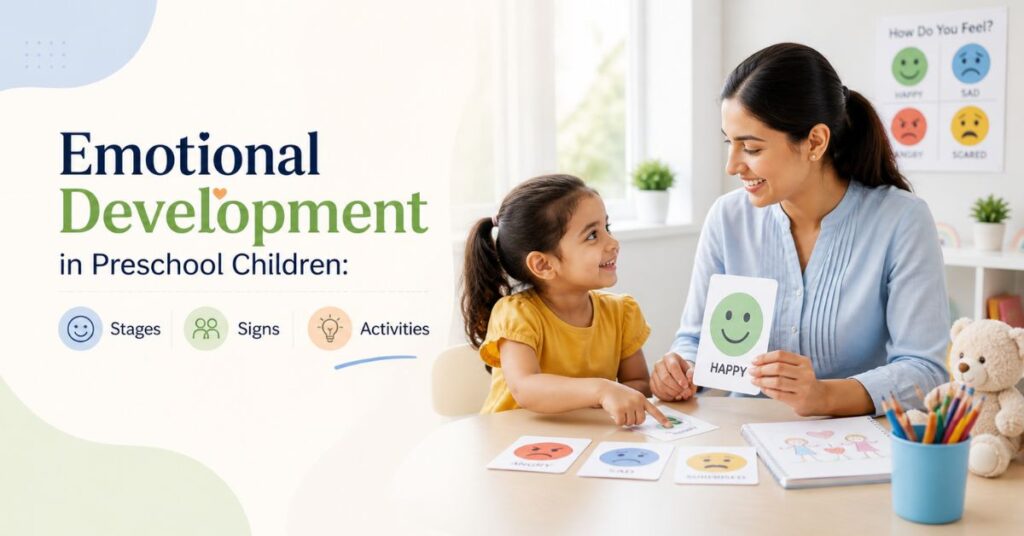
Socio-emotional development covers a child’s ability to manage feelings, build friendships, and cooperate with others. This domain is often underestimated, yet it strongly predicts long-term wellbeing and academic success.
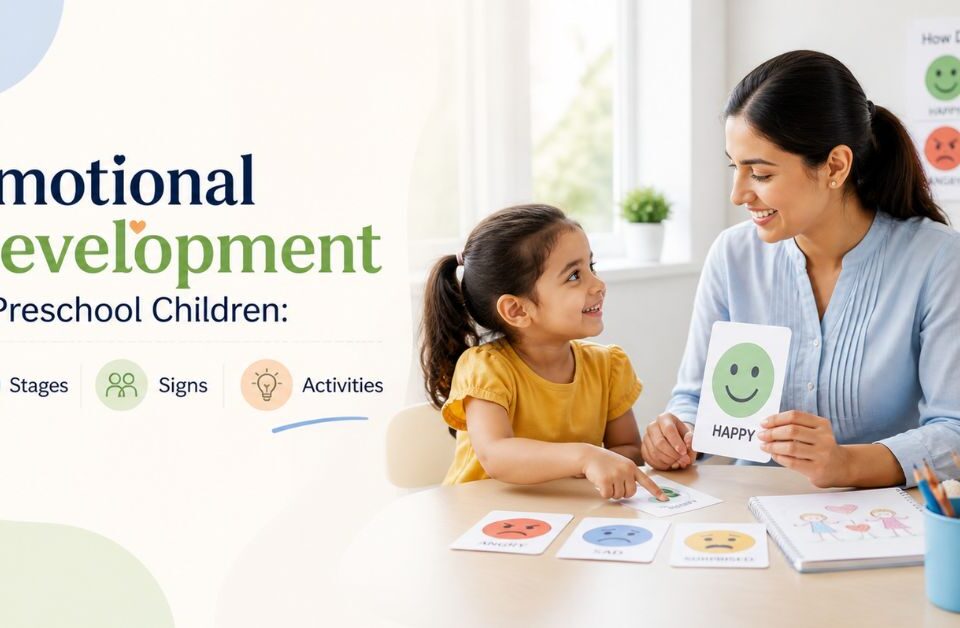
Group activities in a quality early childhood education setting teach children to take turns, share materials, resolve small disagreements, and express emotions with words instead of frustration or withdrawal.
Children who build these skills early tend to settle into primary school more smoothly, since they arrive already comfortable with classroom routines, group work, and following instructions from an adult outside the family.
Emotional regulation, in particular, is closely linked to later academic performance. A child who can calm down after frustration, or wait their turn without distress, is far better positioned to concentrate once formal schooling begins.
How Early Childhood Learning Builds Creativity and Cultural Awareness
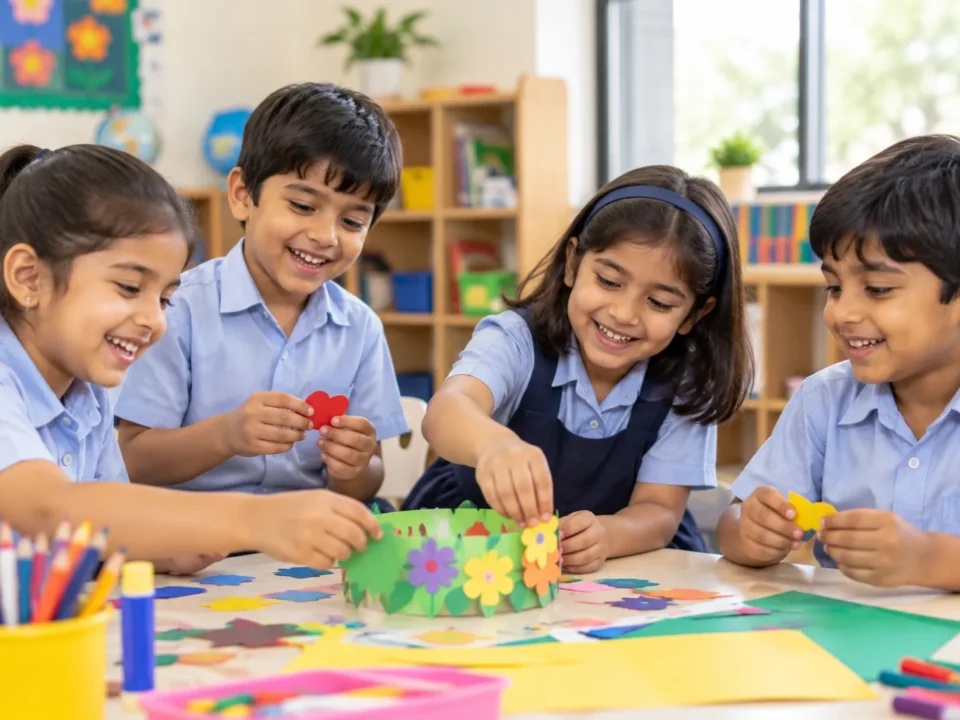
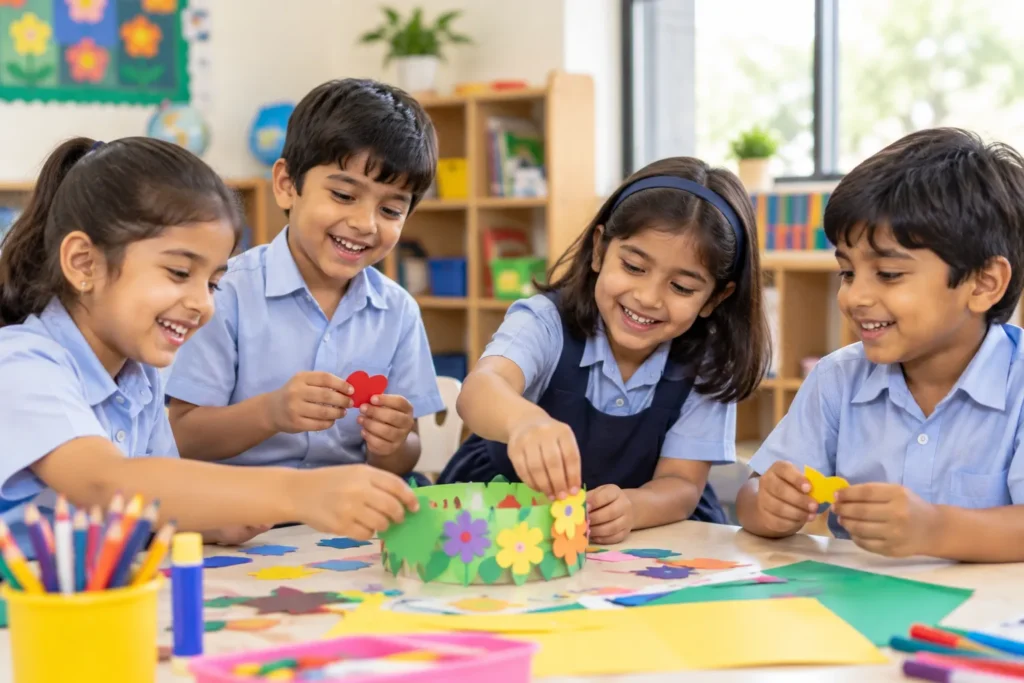
The final domain, aesthetic and cultural development, is often the most enjoyable part of early childhood learning for children themselves. It includes art, music, dance, drama, and exposure to stories and festivals from different communities.
Creative activities give children a safe outlet for self-expression and imagination, while also building fine motor skills and confidence in trying new things without fear of getting it wrong.
Exposure to India’s diverse cultural traditions during these early years also helps children develop a sense of identity and respect for different backgrounds, values that carry forward well beyond the classroom.
Simple activities such as clay modelling, colouring, free drawing, and listening to regional folk tales all count as valuable aesthetic learning, and none of them require expensive materials or a formal classroom setting.
Early Childhood Education vs Formal Schooling
Parents sometimes assume early childhood education should look like a smaller, simpler version of primary school. In practice, the two are built on very different principles.
- Early childhood education: play-based, flexible routines, informal observation-based assessment, focus on holistic development
- Formal schooling: subject-based timetables, structured lessons, written assessments, focus on academic progression
Understanding this difference helps parents avoid pushing formal, textbook-style learning too early, which research suggests can create unnecessary pressure without offering any real long-term academic advantage.
The Role of Play in Early Childhood Education
Play is not a break from learning during the early years. It is the primary method through which early childhood learning actually happens, and this is backed by both policy and research.
Through pretend play, a child practises language, negotiation, planning, and problem-solving all at once, often without realising they are learning anything at all.
The NCF for the Foundational Stage explicitly recommends play-based and activity-based pedagogy for children aged three to eight, moving away from textbook-driven instruction that does not suit this age group.
Even simple, unstructured play, such as building a den from cushions or inventing a game with household objects, holds real developmental value. Parents do not need elaborate toys or apps to support meaningful early childhood learning at home.
Long-Term Outcomes Linked to Early Childhood Education
The benefits of early childhood education are not limited to the pre-school years themselves. International research has repeatedly linked quality early learning to stronger outcomes many years later.
- Better readiness for primary school and smoother transitions into Class 1
- Improved reading and numeracy performance in later grades
- Stronger social skills, including cooperation and conflict resolution
- Higher secondary school completion rates in longitudinal studies from several countries
- Long-term economic and social benefits, as reflected in return-on-investment studies of early learning programmes
While outcomes vary by context and access, the overall direction of the evidence is consistent: time and attention invested in early childhood learning rarely go to waste.
The Role of Parents and Caregivers
No early childhood education programme, however well designed, can replace the influence of a child’s home environment. Parents and caregivers remain a child’s first and most consistent teachers.
Simple daily habits such as reading aloud, talking through everyday tasks, singing together, and allowing unstructured play all contribute meaningfully to a child’s development, often more than expensive toys or gadgets.
Staying in close contact with a child’s teacher or Anganwadi worker also helps parents understand what is being taught and how to reinforce the same skills at home in a natural, low-pressure way.
It also helps to resist comparing one child’s pace of development to another’s. Every child follows their own timeline within a broad normal range, and gentle encouragement tends to work far better than pressure or comparison.
Signs a Child Is Ready to Move Into Primary School
Many parents ask how to know if their child has benefited enough from early childhood education to move confidently into Class 1. A few general signs can help, though every child develops at their own pace.
- Can follow two or three simple instructions in sequence
- Shows interest in books, stories, or letters and numbers
- Can separate from a parent or caregiver without prolonged distress
- Plays cooperatively with other children for short periods
- Manages basic self-care tasks such as washing hands or using the toilet independently
These are general guides rather than strict benchmarks. A teacher or paediatrician is always the best resource if parents have specific concerns about a child’s development.
Choosing a Quality Early Childhood Education Programme
With so many options available, from Anganwadi centres to private pre-schools, choosing the right setting for early childhood learning can feel overwhelming. These practical checks make the decision easier.
- Observe a session in person: watch whether children are actively engaged through play, or simply seated and instructed for long periods.
- Check the caregiver-to-child ratio: smaller groups generally allow more individual attention and responsiveness.
- Ask about the curriculum approach: look for play-based, activity-based methods rather than heavy worksheet use for very young children.
- Assess safety and hygiene: clean toilets, safe play equipment, and clear emergency procedures are non-negotiable basics.
- Look for trained staff: caregivers trained in early childhood development tend to respond more effectively to a child’s individual needs.
- Talk to other parents: honest feedback from current families often reveals details that a brochure or website will not.
Common Challenges in Early Childhood Education in India
Despite growing awareness, early childhood education in India still faces real gaps, particularly outside major cities. Understanding these challenges helps set realistic expectations for parents and policymakers alike.
Many Anganwadi centres continue to face shortages of trained staff, learning materials, and adequate infrastructure, which affects the consistency of care and learning a child receives.
Analysis published by the ASER Centre has highlighted uneven progress in pre-school enrolment and quality since NEP 2020 was introduced, with rural areas generally lagging behind urban centres.
Awareness gaps also play a role. Some families still view the pre-school years mainly as childcare rather than a genuine stage of development, which can lead to less structured stimulation during these critical years.
Efforts to co-locate Anganwadi centres with primary schools, along with the rollout of the National Curriculum Framework for the Foundational Stage, are gradually narrowing these gaps across several states.
Digital Media and Screen Time During the Early Years
Screens are now a constant presence in most households, which makes screen time a genuine concern within modern early childhood education. Excessive, unsupervised use can crowd out the hands-on play and conversation that this stage depends on.
Health and education experts generally recommend minimal screen exposure for children under two, with only limited, supervised, and high-quality content for children between two and six years of age.
When screens are used, co-viewing with a parent and discussing what is being watched turns passive viewing into an interactive activity, which supports language development far better than screen time alone.
Frequently Asked Questions
At what age should early childhood education start?
Early childhood education can begin from birth through simple stimulation and bonding at home, with structured programmes typically starting around age three in Anganwadi centres or pre-schools.
Is early childhood education the same as preschool?
Preschool is one setting where early childhood education takes place. The term early childhood education is broader and includes home-based learning, Anganwadi centres, and any structured or informal learning before Class 1.
How does early childhood education affect brain development?
Since most of a child’s brain development happens before age six, rich and responsive early experiences directly shape neural connections that support memory, language, and reasoning throughout life.
What is the ECCE stage under NEP 2020?
ECCE refers to Early Childhood Care and Education, the first three years of the Foundational Stage under NEP 2020, covering children aged three to six before they enter Class 1.
Can parents support early childhood learning without a formal programme?
Yes. Reading aloud, conversing often, encouraging play, and providing a safe, stimulating environment at home all support early childhood learning, even without enrolment in a formal centre.
Why is play considered important in early childhood education?
Play allows children to practise language, problem-solving, and social skills naturally and without pressure, which research shows is more effective for this age group than formal instruction alone.
Is it normal for children to develop at different speeds?
Yes. Development within early childhood education follows a broad range rather than a fixed timeline, and most variation between children of the same age is completely normal.
How much screen time is appropriate during early childhood?
Most guidance suggests avoiding screens for children under two, and limiting screen time to short, supervised, high-quality content for children between two and six years old.
Conclusion
Early childhood education is not a head start reserved for a lucky few. It is a critical stage of human development that shapes how a child thinks, communicates, feels, and relates to others for the rest of their life.
From India’s ECCE framework under NEP 2020 to simple daily habits at home, every layer of early childhood learning works together to build a foundation strong enough to carry a child through school and beyond. Parents, caregivers, and educators who invest in these years are investing in outcomes that last a lifetime.