
Nursery vs Kindergarten: Key Differences Parents Should Know
December 20, 2025
Difference Between Kindergarten and Primary School Guide
December 31, 2025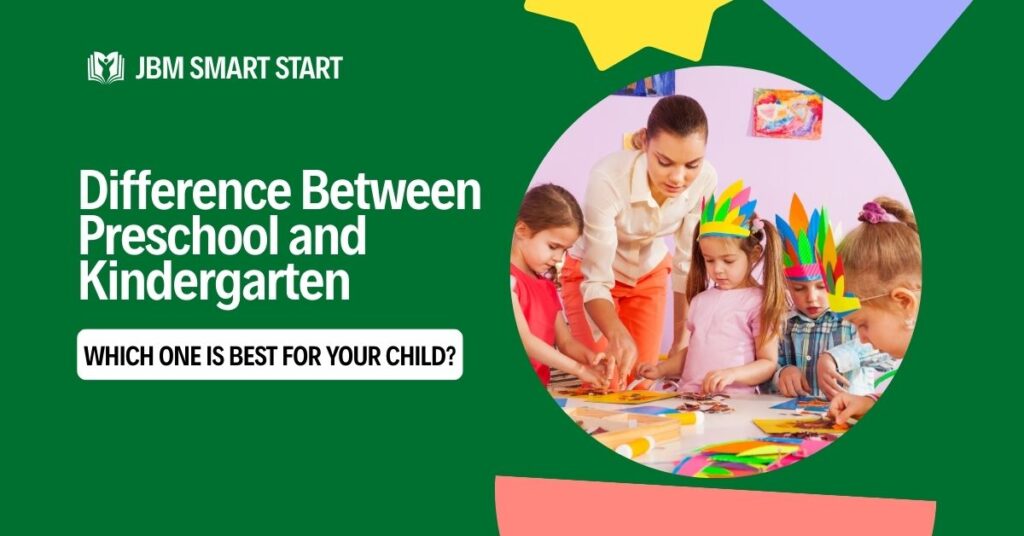
Difference Between Preschool and Kindergarten: Which One Is Best for Your Child?
Preschool vs Kindergarten: Why This Decision Matters in Early Childhood Education
Every parent eventually reaches a crossroads where one sign points to preschool and another to kindergarten. A child’s early years are like wet clay. They’re gentle, impressionable, ready to take shape.
That’s why the difference between preschool and kindergarten is so important. What really happens in a preschool? How is kindergarten different? Which one shapes the foundation better?
And most importantly, between preschool vs kindergarten, what’s best for your child?
What Is Preschool? Meaning, Purpose & Early Learning Benefits
Preschool is often a child’s first step into the world beyond their homes. That’s why these early learning programs are gentle, play-led, and emotionally enriching.
It’s basically a place where imagination is welcome at the lunch table, where colours spill outside the lines, and where counting blocks matters more than counting marks.
Core Focus of Preschool Education
- Social skills & communication
- Basic motor skills like holding crayons, running, & hopping
- Early introduction to numeracy & literacy
- Building curiosity by playing
- Routine, discipline, sharing, & waiting for one’s turn
Preschool Age Group: What Is the Right Age to Start?
Between preschool and kindergarten age, the former is usually for children aged between 2.5 to 4 years old.
Also Read: 12 Reasons Why Preschool Education is Important
What Is Kindergarten? Structure, Learning Goals & School Readiness
In preschool vs kindergarten, if the former is a warm-up, then the latter is the first lap of your child’s academic journey. The entire setup of kindergarten is quite structured, slightly academic, but still gentle enough to encourage creativity.
However, it welcomes children who are a little more independent. Thus, kindergarten readiness is expected from those who can sit through short sessions, follow instructions, and are ready for foundational academics.
Core Focus of Kindergarten Curriculum
- Pre-reading & writing skills
- Number sense, shapes, & patterns
- Classroom behaviour & collaborative learning
- Early problem-solving skills
- Confidence-building for primary schooling
Also Read: Difference Between Kindergarten and Primary School Guide
Kindergarten Age Group: When Is a Child Ready to Start Kindergarten?
Between preschool curriculum vs kindergarten, the latter is slightly more complicated; the age group usually ranges from 4 to 6-year-old children. It prepares them for class 1.
Preschool vs Kindergarten: Key Differences Every Parent Should Know
Let’s take a closer look at the difference between preschool and kindergarten!
1. Learning Approach: Play-Based Learning in Preschool vs Structured Learning in Kindergarten
Preschool programs are mostly based on playing freely, exploring senses, enjoying music, art, movement, and curiosity-driven activities.
Hence, the curriculum encourages children to learn by touching, building, splashing, pretending, etc. That’s because, at this age, playing is their only language of learning.
Kindergarten, on the other hand, gently introduces structure in children’s daily routine. Their learning still involves fun, but the activities now have clearer goals.
They are exposed to phonics sessions, beginner worksheets, number games and pattern recognition. Thus, children gradually learn to follow a routine, participate in guided tasks, and develop discipline.
2. Age Difference Between Preschool and Kindergarten: Why Readiness Matters More Than Age
Preschool and kindergarten ages are very different. That’s because even the maturity levels of children differ while they’re growing up. The preschool age is usually 2.5 years to 4 years. However, this also depends on their emotional maturity and developmental progress.
In contrast, kindergarten welcomes children from 4 years to 6 years. It bridges the stage before Class 1, where children move from play-foundation to concept-based learning. While age gives a starting point, what truly matters is their capabilities and competency.
A 4-year-old who still needs emotional grounding may thrive better in preschool. Meanwhile, another 4-year-old who is eager to learn letters may be ready for kindergarten. Hence, your child needs to lead, and the system will automatically follow.
3. Development Goals: Social Skills vs Academic Readiness
Preschool, like other early learning programs, strengthens foundational areas. These include basic social behaviours, emotional expression, sharing, taking turns, motor development, and self-help skills.
The purpose is to help a child get comfortable in a group environment away from home. By the time the transition from preschool to kindergarten happens, your child is ready for basic academics.
Thus, in kindergarten, their vocabulary expands, they begin recognising letters, forming strokes, understanding quantities, sorting shapes, and solving minor problems.
4. Classroom Activities & Learning Environment: How Preschool and Kindergarten Differ
Preschool classrooms feel like a children’s wonderland. They have bright colours, toy corners, story mats, puzzles, sand tables, and pretend kitchens. Thus, the learning is spontaneous and guided by faculty members.
A day in a preschool may involve singing, clay modelling, running outdoors, or identifying animals on picture cards.
But, between preschool curriculum vs kindergarten, the latter is more structured. Children are instructed to sit for short learning periods, practice writing, engage in phonics drills, math problems, and theme-based projects.
In this setting, their creativity definitely stays alive, but now it also works hand-in-hand with discipline and focus.
5. Level of Independence: What Is Expected from Preschoolers vs Kindergarteners
The main difference between preschool and kindergarten is that preschoolers are still learners of life. Zippers may confuse them, snack time will need reminders, sometimes tears happen, and sometimes cuddles solve everything.
That’s why teachers assist them closely with routines and emotional comfort. A kindergartner, on the other hand, is encouraged to participate more independently. They learn to organise bag items, wash their hands, wait their turn, and answer in class.
Thus, students in kindergarten learn to be responsible and maintain discipline, which gradually builds their competency for class 1.
6. Assessment Style & Learning Outcomes in Preschool and Kindergarten
Preschool assessments are observational. Hence, teachers notice behaviour, interaction, motor growth and cognitive curiosity. A child’s progress and their kindergarten readiness are evaluated based on their confident participation.
In kindergarten, the learning outcomes are slightly more measurable. Hence, teachers track a child’s letter recognition, counting ability, tracing/writing skills, phonemic awareness, and comprehension of basic instructions.
The environment is still stress-free, but structured enough to prepare children for class 1.
Also Read: Difference Between Nursery and Kindergarten: A Helpful Guide for Parents
Is Your Child Ready for Kindergarten? Key Readiness Signs Parents Should Look For
Kindergarten readiness may not occur in the same way for every five-year-old. Some are competent in reading and writing, while others may still be preparing for the same.
Hence, it isn’t about being academically ahead. Instead, it’s about being emotionally prepared. That’s why it’s important to ask yourself:
- Can my child follow simple instructions?
- Do they understand sharing and taking turns?
- Can they express needs verbally?
- Sit for 15-20 minutes at a stretch?
- Hold pencils/spoons comfortably?
- Show curiosity about numbers, letters, and stories?
If the answer to these questions is yes, your child has accomplished kindergarten readiness. If not, another year of preschool will help them in their growth and development.
Transition from Preschool to Kindergarten: Tips for a Smooth & Confident Move
New routine, new faces, and more responsibility can feel daunting. However, the transition from preschool to kindergarten can be made smooth with the following tips:
- Start reading stories about school days
- Encourage simple chores like packing bags, organising toys, etc.
- Practice short writing strokes or letter recognition
- Maintain consistent sleep schedules
- Ask, listen, and reassure
Also Read: How to Prepare Your Child For the First Day of School?
Preschool vs Kindergarten: Final Verdict to Help Parents Make the Right Choice
Thus, despite the difference between preschool and kindergarten, both are essential for your child’s growth and development.
If your child is below 4 years and is just stepping into structured learning, they will need social exposure and routine. In that case, a preschool will be perfect for them, where they will learn by playing.
On the other hand, if your child is already comfortable in groups, shows interest in early academics, and can sit through short lessons, they are ready for kindergarten, which will prepare them for class 1.
Basically, it’s not preschool vs kindergarten, but rather preparing your children for higher academic levels.
Give your child a comfortable start at JBM Smart Start! Watch them explore their creativity, build confidence, and develop a love for learning. Admissions open now for the session 2026-27! Enrol now!
Also Read: How to Choose the Right Preschool For Your Child?
Frequently Asked Questions About Preschool vs Kindergarten
Q1: What is the main difference between preschool and kindergarten?
Ans: Preschool focuses on early social and emotional development with playful activities. On the other hand, kindergarten introduces structured academic concepts like reading, writing, and numbers. This prepares the children for class 1.
Q2: Can a child go directly to kindergarten without preschool?
Ans: Yes, that is possible. However, children who attend preschool usually adjust faster socially and emotionally when they enter kindergarten.
Q3: What is the right age for preschool and kindergarten?
Ans: Preschool usually starts around 2.5-4 years, whereas kindergarten typically begins between 4-6 years. The exact ages may vary depending on a particular school’s rules and regulations.
Q4: How do I know if my child is ready for kindergarten?
Ans: You can check for indicators like communication, early independence, attention span, ability to follow instructions, and curiosity toward numbers/letters.
Q5: Should I choose preschool or kindergarten for a 4-year-old child?
Ans: The answer depends on your children’s competence and development, instead of their age. If they’re confident socially and can manage basic tasks, kindergarten is suitable. Otherwise, preschool will offer the foundation they need!