
Daycare vs Preschool: Key Differences for Parents
November 28, 2025
Difference Between Preschool and Kindergarten: Which Is Right for Kids
December 22, 2025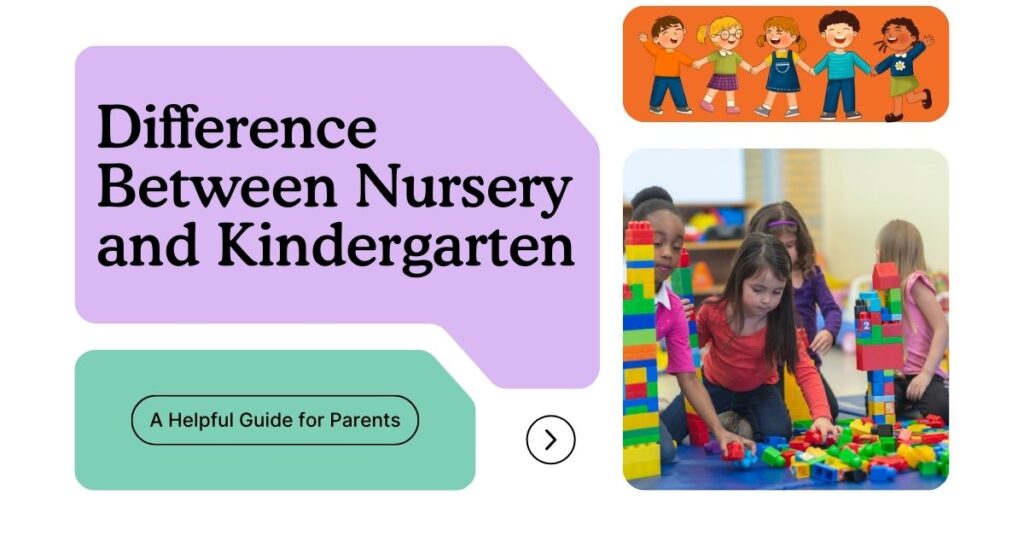
Difference Between Nursery and Kindergarten: A Helpful Guide for Parents
Nursery vs Kindergarten: Why Understanding the Difference Matters for Parents
There are multiple pre-primary education levels available today; hence, parents are often confused about the difference between nursery and kindergarten. Are they both necessary? Which one truly supports a child’s early developmental needs?
Actually, these terms are sometimes used interchangeably; however, they serve distinct purposes in a child’s learning journey during different stages of their growth.
Hence, once you clearly understand nursery vs kindergarten and how both fit into the broader pre-school ecosystem, you will be able to make well-informed decisions.
What Is Nursery Education? Meaning, Age Group & Purpose
Nursery is the first formal step in pre-primary education levels. It is usually designed for children who are aged between 2.5 to 4 years. The purpose of the system is not really academic; instead, it’s to help children get through the developmental stages.
That’s why schools that understand the true nursery meaning in education offer an enriching environment where children feel safe, supported, and encouraged.
They also develop socio-emotional skills and early independence skills such as eating by themselves, responding to instructions, and interacting confidently with their peers.
Also Read: Difference Between Playgroup and Nursery: Everything Parents Need to Know
What Is Kindergarten? Age Group, Curriculum & Learning Focus
Kindergarten is usually the final stage before formal schooling begins. Hence, the kindergarten age group usually includes children aged 4 to 6.
While the nursery has a play-based curriculum, kindergarten includes guided learning, planned activities, early worksheets, reading exercises, phonics, counting, cognitive-building games, and experiential learning sessions that prepare children for Class 1.
Thus, this early education curriculum helps children build pre-academic skills in literacy, numeracy, problem-solving, creative expression, and environmental awareness!
Also Read: Difference Between Kindergarten and Primary School Guide
Nursery vs Kindergarten: 5 Key Differences Every Parent Should Know
Let’s discuss nursery vs kindergarten in detail!
1. Age Group and Developmental Readiness
The first and most essential difference between nursery and kindergarten lies in the age and competence of the child. Nursery typically welcomes children who are aged between 2.5 and 4 years.
Basically, children who are in a phase where they are just beginning to explore the world beyond home. At this stage, emotional security, social comfort, and sensory learning form the backbone of their development.
The kindergarten age group, on the other hand, usually includes children aged 4 to 6 years. These kids are naturally more independent, curious, and ready for guided learning.
Also Read: What Is The Right Age For Play School Admission?
2. Learning Approach & Classroom Environment
Nursery vs preschool difference also lies in their respective classrooms. The former follows a play-based and exploratory approach where children learn by touch, movement, colour, sound, and imitation.
The environment is intentionally unpressured to help them settle, adapt, and engage at their own pace. Kindergarten classrooms, however, introduce structured routines such as circle time, early writing strokes, phonics, numbers, and cognitive games.
Thus, the learning remains activity-based; however, the classroom rhythm is more predictable and is directed towards preparing them for formal schooling.
3. Curriculum Goals & Early Learning Outcomes
Among the various pre-primary education levels, a nursery focuses on developing foundational skills in a child. This includes communication, expression, fine and gross motor abilities, social interactions, and emotional regulation.
That’s why teachers encourage children to explore freely, interact naturally, and understand the world with sensory-rich experiences.
The early education curriculum of kindergarten shifts towards building pre-academic competence.
Children engage in guided reading activities, beginner numeracy, problem-solving tasks, storytelling, craft-based comprehension, and simple projects that develop early logic and memory. This level bridges the gap between playful exploration and structured learning!
4. Independence Level & Daily Responsibilities
In nursery, children are still heavily dependent on teachers for emotional reassurance, daily routines, conflict management, and settling into group settings.
That’s why such a setting needs skilled educators who will model behaviours, guide interactions, and create a safe space for children.
Between nursery vs kindergarten, the latter encourages children to take more responsibility. They are taught to organise their belongings, complete simple tasks independently, respond to instructions, and participate confidently in group activities.
This shift in independence helps them meet the expectations of primary school!
5. Role of Nursery and Kindergarten in Early Education
Nursery vs preschool also lies in their educational purpose. Nursery acts as a gentle entry point into the world of education.
Thus, it shapes early trust, emotional resilience, sensory awareness, and social familiarity. It lays the essential groundwork upon which future learning can be built.
Kindergarten, on the other hand, serves as the bridge to formal schooling. It prepares children for higher academia, builds a cognitive foundation, and teaches the behavioural maturity required to transition smoothly into Class 1.
Also Read: Differences Between Pre-Primary and Primary Schools: Which Stage Is Crucial for Your Child?
Final Thoughts: Choosing Between Nursery and Kindergarten
Thus, there’s definitely a significant difference between nursery and kindergarten. However, they form an essential part of early childhood education.
The right choice lies in looking for the perfect school that values holistic development between nursery vs kindergarten and ensures that your child receives the strongest start to their educational journey.
Give your child the perfect start with age-appropriate learning, compassionate teachers, and an engaging curriculum at JBM Smart Start! Explore today and take the first step in transforming your child into a confident, joyful learner!
Also Read: Difference Between Daycare and Preschool: What’s Right for Your Toddler?
Frequently Asked Questions About Nursery vs Kindergarten
Q1: What is the main difference between nursery and kindergarten?
Ans: Nursery focuses on early social, emotional, and sensory development. The difference is that kindergarten prepares children for formal schooling with the help of structured pre-academic learning.
Q2: What is the typical age group for nursery and kindergarten?
Ans: Nursery generally includes children aged 2.5 to 4 years. The kindergarten age group, on the other hand, includes children aged 4 to 6 years.
Q3: Is nursery compulsory before kindergarten?
Ans: Not really. However, a nursery helps children adjust to a structured environment. It makes the transition to kindergarten smoother. Hence, if your child struggles with adapting to new surroundings, a nursery will help them transition to other pre-primary and primary levels.
Q4: How is nursery different from preschool?
Ans: Preschool is a broader term that may include nursery, kindergarten, and other early-education levels, whereas nursery is specifically the first step in formal early learning.
Q5: How can parents choose the right level for their child?
Ans: Parents must consider their child’s competence level, comfort in social settings, independence levels, and the teaching philosophy of the school. This will help them make the right choice!