
10 Signs Your Child Is Ready for Preschool: Parent Guide
May 21, 2026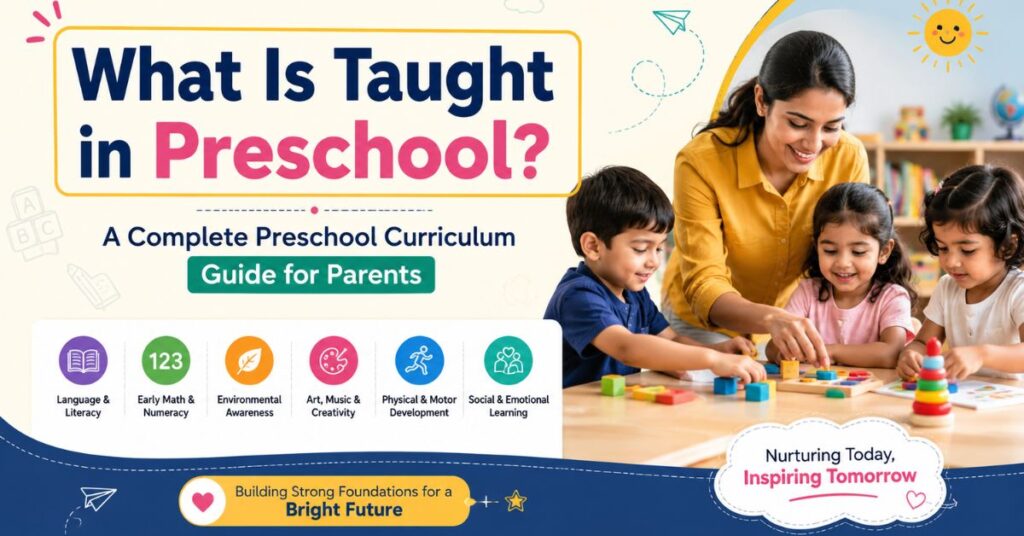
What Is Taught in Preschool? A Complete Preschool Curriculum Guide for Parents
Why Understanding the Preschool Curriculum Matters for Parents
Preschool is the most important part of your child’s learning journey because it lays the foundation of their future education. Since it plays such a significant role in your child’s life, it often makes us wonder exactly what is being taught in preschool.
The truth is that a strong preschool curriculum goes far beyond academics. It is a space where children begin learning how to communicate, explore, think independently, solve problems, and interact with the world around them.
Thus, these early years build the foundation for future learning and emotional development. Let’s find out more details about the preschool curriculum with the help of this blog!
What Is a Preschool Curriculum? Understanding Early Childhood Learning
The admission age for children in a preschool is around 2-6 years old. Hence, the preschool curriculum is also designed accordingly for the growth and development of the little ones.
It focuses on age-appropriate experiences that help children develop cognitive, physical, social, and emotional skills. Additionally, early childhood curriculum structure is also characterised by:
- Play-based learning
- Language & communication development
- Pre-math & problem-solving skills
- Physical coordination activities
- Creativity & self-expression
- Emotional & social learning
- Life skills & independent habits
Thus, the purpose of a preschool education program is not really restricted to formal lessons. Instead, it prioritises joyful, fun, and easy-going experiences to prepare kids for higher education and life.
Also Read: What Is the Right Age to Start Preschool or Nursery in India?
Preschool Syllabus in India: Key Subjects & Skills Taught in Preschool
With the changing education space, the preschool syllabus in India has also kept up. It is heavily influenced by the National Education Policy (NEP) and Early Childhood Care and Education (ECCE) guidelines.
Now, the focus is more on experiential learning instead of meaningless memorisation. The following list of subjects taught in preschool exposes children to multiple learning areas with structured and playful experiences:
1. Language & Literacy Development: Building Communication Skills in Preschool
Language forms a major part of the nursery school curriculum. Children learn to recognise letters, learn phonetics, build their vocabulary, listen to stories, have fun with rhymes and songs, exercise their speaking and listening skills, and practice saying full sentences in their conversations with their classmates and teachers.
Thus, instead of memorising, they learn language naturally by interacting and participating in activities. These are among the most important skills taught in preschool because literacy and communication affect their future academic success.
2. Early Mathematics & Numeracy Skills Children Learn in Preschool
The preschool syllabus in India does not teach your children complicated calculations. Instead, they begin to recognise numbers, learn counting, identify shapes and patterns, play sorting and matching games, get familiar with sizes and measurements, and use logic to solve problems.
These activities become even more engaging and fun when teachers use toys, blocks, and puzzles for the kids.
3. Environmental Awareness & General Knowledge Activities in Preschool
One of the primary preschool learning goals is to help children understand the world around them.
That’s why, in a preschool setting, they’re encouraged to explore animals, birds, plants, nature, weather, seasons, family relationships, culture and festivals, transportation, and their everyday surroundings. It teaches them to be curious, observe keenly, and learn beyond books.
4. Art, Music & Creative Expression in Preschool Education
Creativity is an essential part of a child’s growth. It expands their imagination and teaches them to live life to the fullest. That’s why a preschool education program also includes the following creative activities:
- Drawing and colouring
- Clay modelling
- Art and craft
- Singing
- Dance and movement
- Music activities
- Dramatic play
It’s recommended not to underestimate the contribution of creative activities in a child’s normal development. It actually teaches them to express emotions and improve their coordination.
5. Physical Development & Motor Skills Activities for Preschoolers
Your child should be extremely active in their early years. This is guaranteed by the early childhood curriculum structure. It includes activities such as running, jumping, balancing, sports, and other high-movement games. But that’s not all.
A preschool education program also offers innovative activities that teach kids how to grip their pencils, trace on paper, safely cut with scissors, fold fabric, etc. These physical activities support body coordination, concentration, and independence.
Moreover, many modern schools incorporate yoga and movement-based learning to improve their emotional well-being.
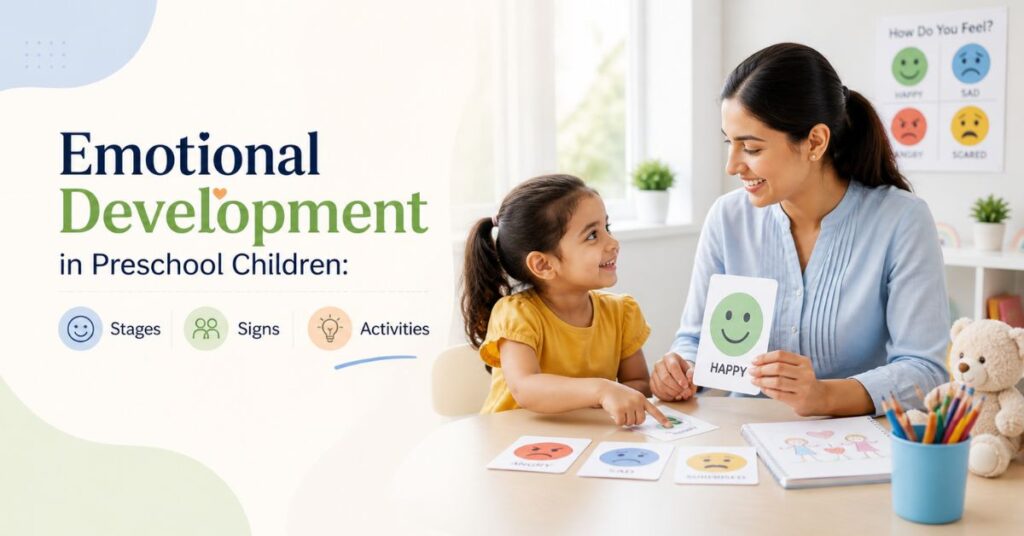
6. Social & Emotional Learning: Essential Life Skills Taught in Preschool
Social interaction may be normal for adults, but it needs to be taught to children from early childhood. It is one of the most valuable skills taught in preschool.
They gradually start understanding sharing, teamwork, empathy, patience, emotional expression, classroom routines, respect, cooperation, and conflict resolution.
Mind you, they are never advised to hide or suppress their emotions. Instead, they are guided to navigate their emotions in a healthy way.
Also Read: 10 Signs Your Child Is Ready for Preschool: A Complete Guide for Parents
Montessori vs Traditional Preschool Curriculum: Key Differences
The following table will help you clearly understand a comparison between the Montessori preschool curriculum and the traditional preschool education program:
| Aspect | Montessori Preschool Curriculum | Traditional Preschool Curriculum |
| Learning Approach | Child-led and self-paced learning | Teacher-guided and structured learning |
| Classroom Environment | Flexible and exploration-based | More structured and routine-oriented |
| Role of the Teacher | Facilitator and observer | Instructor and classroom leader |
| Teaching Method | Hands-on activities and experiential learning | Group instruction and guided activities |
| Learning Pace | Based on each child’s readiness and interest | Follows a common classroom pace |
| Focus Area | Independence, self-discovery, and practical skills | Academic readiness and classroom discipline |
| Learning Materials | Montessori tools and sensory materials like blocks, puzzles, etc. | Worksheets, classroom resources, books, and activity tools |
| Child Participation | High level of choice and self-direction | Guided participation with teacher support |
| Skill Development | Independence, concentration, problem-solving | Listening, routine-following, and foundational academics |
| Assessment Style | Observation-based progress tracking | Teacher evaluation and milestone-based assessment |
| Social Interaction | Mixed activities and collaborative learning | Group learning and classroom interaction |
| Best For | Children who thrive by exploring and learning independently | Children who benefit from structured guidance and routines |
Many modern preschools today, including progressive foundational schools, combine the strengths of both approaches.
This balanced model allows children to enjoy the independence and curiosity encouraged by the Montessori preschool curriculum while also benefiting from structured foundational learning and guided classroom experiences from the traditional preschool education program.
JBM Smart Start is one such foundation preschool that offers the best of both worlds for your child.
Also Read: Montessori vs Traditional Preschool: Which One is Right for Your Child?
How JBM Smart Start Builds Strong Early Learning Foundations
JBM Smart Start emphasises the holistic development of children. For this, the preschool curriculum integrates Montessori-inspired learning with experiential and activity-based education. The school also abides by modern ECCE and foundational learning principles.
Children are exposed to various activities like storytelling, reading, interactive learning, music and movement, creative exploration, digital learning, yoga, sports, play-based discovery, and communication and confidence-building.
Thus, this educational institution refuses to focus on academics alone. Instead, it encourages curiosity, independence, and emotional growth with its preschool curriculum.
Choose the Right Preschool for Your Child’s Future Growth
If you are looking for one of the best preschools in Greater Noida where children learn by exploring their creativity along with strong foundational development, JBM Smart Start is perfect for growing minds. Explore how the right preschool journey can help your child build skills, confidence, and a genuine love for learning. Admissions now open for 2026-27!
Also Read: List of Best Preschools in Greater Noida 2025–2026
Frequently Asked Questions About Preschool Curriculum & Learning
1: What is included in a preschool curriculum?
Ans: A preschool curriculum usually includes language development, early mathematics, creativity, physical activities, social learning, and life skills. These are usually play-based and taught using age-appropriate methods.
2: What are the main subjects taught in preschool?
Ans: The subjects taught in preschool commonly include language, numeracy, environmental awareness, art, music, movement, and social-emotional learning.
3: Is the preschool syllabus in India academic?
Ans: The modern preschool syllabus in India focuses more on experiential and developmental learning than formal academics. Thus, it helps children build foundational skills by playing and exploring.
4: What is the Montessori preschool curriculum?
Ans: A Montessori preschool curriculum promotes hands-on learning, independence, self-paced discovery, and practical life experiences. These are essential in preparing for formal education and future careers.
5: What skills are taught in preschool?
Ans: The most important skills taught in preschool include communication, problem-solving, teamwork, emotional regulation, motor coordination, and independent thinking.
6: How does preschool prepare children for kindergarten?
Ans: A strong preschool education program develops literacy, numeracy, concentration, social behaviour, and confidence. This makes their transition to primary school smooth and supports long-term academic success.